

Introduction to MSTSC
MSTSC is the command-line launcher for Remote Desktop Connection in Windows 11. The executable is mstsc.exe, and it opens the classic Remote Desktop Connection client that many Windows users still rely on to connect to another Windows PC, a Windows Server, or a remote desktop environment. If you type mstsc in Run, Command Prompt, PowerShell, or Windows Terminal, you are starting that client.
Microsoft documents MSTSC as the command that creates connections to Remote Desktop Session Host servers or other remote computers, edits existing Remote Desktop Connection .rdp configuration files, and migrates older connection files created with Client Connection Manager. In daily Windows 11 use, MSTSC is most often used to connect to a remote PC, open a saved .rdp file, control display behavior, use RD Gateway, or pass special session options.
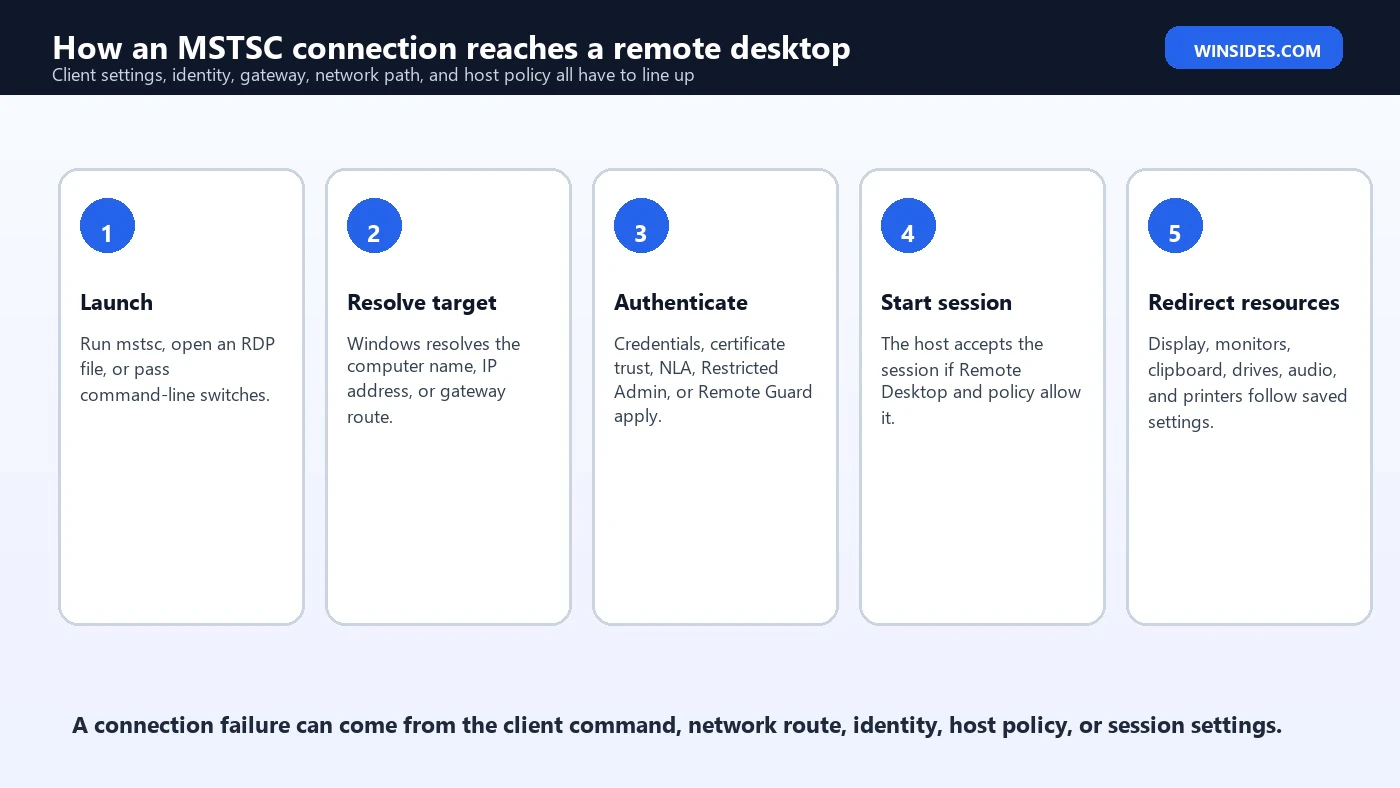
MSTSC is simple on the surface, but it sits at the front of a bigger Remote Desktop stack. A successful connection depends on the client command, the target address, network reachability, Remote Desktop being enabled on the host, account permissions, authentication settings, certificate trust, gateway configuration, and redirection settings. When a connection fails, the command line is only one part of the path.
For official context, Microsoft documents the MSTSC command, connecting to Remote Desktop Services, the Remote Desktop Services overview, and planning access from anywhere.
Table of contents
Key Takeaways
- MSTSC launches Remote Desktop Connection. It is the classic Windows client for RDP connections and saved
.rdpfiles. /vspecifies the target. Use it for a computer name, IP address, or host with port./f,/w,/h, and/multimoncontrol display behavior. These switches are useful when launching repeatable sessions from scripts or shortcuts./gspecifies an RD Gateway server. Gateway configuration matters when the remote host is not directly reachable./adminchanges server administration behavior. Use it only when you understand the server session scenario.- Security switches matter.
/restrictedAdmin,/remoteGuard, and/promptaffect how credentials are handled. - Troubleshooting is layered. Check command syntax, name resolution, network route, host settings, authentication, gateway, and session redirection separately.
MSTSC Syntax
The core MSTSC syntax is compact. You can launch the client by itself, pass a saved .rdp file, edit a saved file, or add command-line switches. The most common mistake is treating every option as a connection fix. Options change the client launch behavior, but they do not enable Remote Desktop on the host, open a firewall, grant account permissions, or repair a gateway.
mstsc
mstsc <connectionfile.rdp>
mstsc /v:<server[:port]>
mstsc /edit <connectionfile.rdp>
mstsc /f
mstsc /w:1600 /h:900
mstsc /multimon
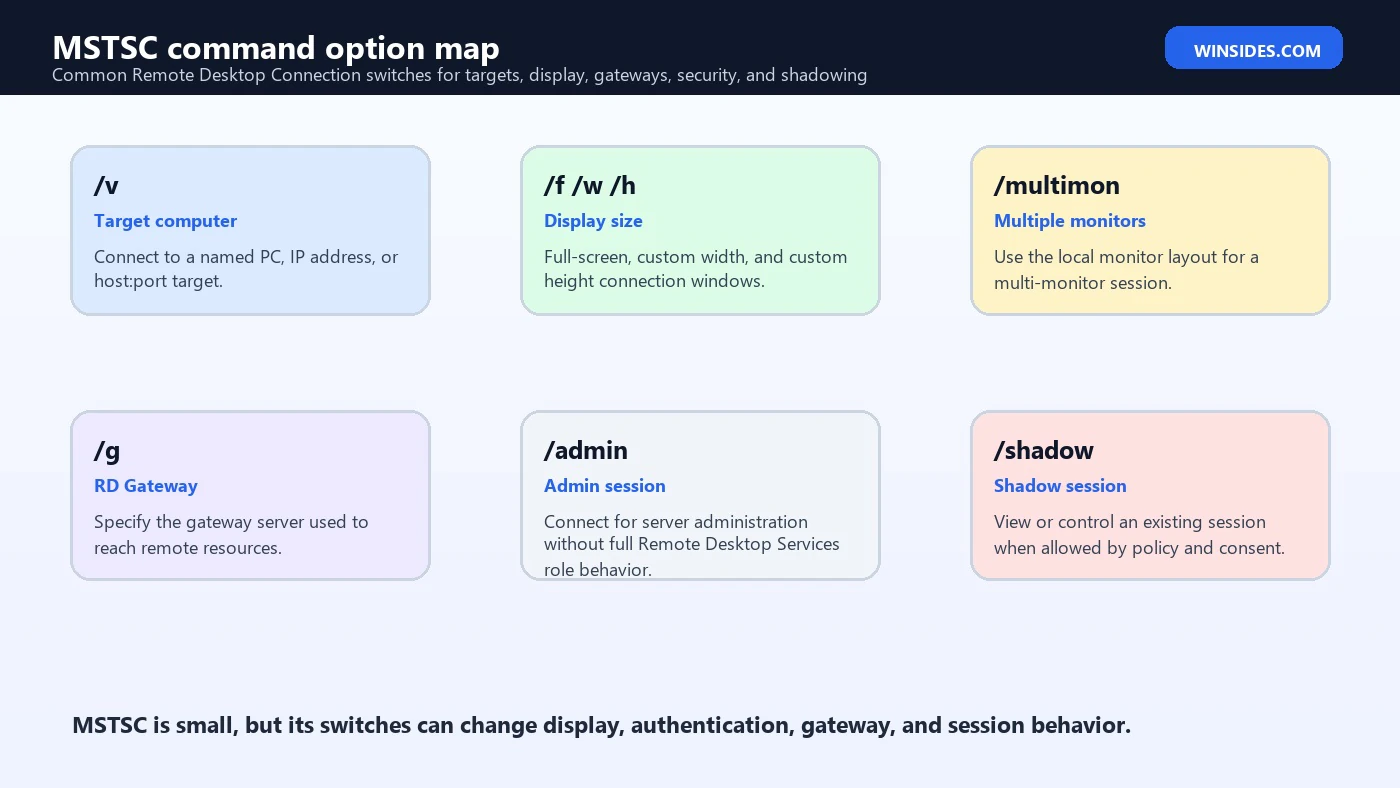
Microsoft’s MSTSC page lists the main parameters, including <connectionfile>, /v, /g, /admin, /f, /w, /h, /public, /span, /multimon, /edit, /restrictedAdmin, /remoteGuard, /prompt, /shadow, /control, /noConsentPrompt, and /migrate. You do not need all of them for a normal connection, but knowing the categories helps you read commands written by others.
Connect to a Remote PC with /v
The /v switch specifies the remote computer. The target can be a computer name, fully qualified domain name, IP address, or host with a port. If the host listens on the default Remote Desktop port, you usually do not need to include the port. If it uses a nonstandard port, append it after a colon.
mstsc /v:PC-Office
mstsc /v:server01.contoso.com
mstsc /v:192.168.1.50
mstsc /v:rdp.example.com:3390
The target must be reachable from your network. If the name does not resolve, MSTSC cannot connect. If the host is behind a VPN, you need the VPN first. If a firewall blocks Remote Desktop, MSTSC cannot fix it from the client side. If Remote Desktop is not enabled on the host, the command can be perfectly written and still fail.
When troubleshooting target problems, separate name resolution from RDP access. Try the exact computer name and IP address if appropriate. Confirm that you are on the right network. For business environments, do not expose RDP directly to the internet just because /v accepts a public name. Use VPN, RD Gateway, or a managed remote access path.
Open and Edit RDP Files
A Remote Desktop Connection file, usually ending in .rdp, stores connection settings. It can include the target computer, display choices, device redirection options, gateway behavior, and other preferences. MSTSC can open one directly or edit it through the Remote Desktop Connection interface.
mstsc "C:\Users\Public\Desktop\OfficePC.rdp"
mstsc /edit "C:\Users\Public\Desktop\OfficePC.rdp"
RDP files are convenient when you connect to the same systems repeatedly. They are also useful for support teams because settings can be standardized. However, treat them as configuration files. Do not blindly open RDP files from untrusted sources. Review the target, gateway, and redirection settings before using them.
If a saved RDP file behaves strangely, open it with /edit and compare the settings with a new clean connection. Saved files can preserve old display settings, gateway choices, or redirection behavior that no longer fits the current network.
Display Options: Full Screen, Width, Height, Span, and Multimon
MSTSC display switches are useful when you want repeatable window behavior. Use /f for full screen. Use /w and /h for a specific width and height. Use /span when the remote desktop should span the local virtual desktop. Use /multimon when the session should match the local monitor layout across multiple monitors.
mstsc /v:PC-Office /f
mstsc /v:PC-Office /w:1600 /h:900
mstsc /v:PC-Office /span
mstsc /v:PC-Office /multimon
Display switches do not guarantee every remote app will scale perfectly. DPI, monitor arrangement, remote session policy, and saved RDP settings can all affect the result. If multi-monitor behavior is wrong, start with a simple one-monitor connection, then add /multimon. If a saved file is involved, edit the file and check display settings there too.
The /l switch is also useful because it enumerates local monitors and their IDs. Use it when you need to understand how MSTSC sees the monitor layout before launching a multi-monitor session.
mstsc /lRD Gateway with /g
The /g switch specifies an RD Gateway server. A gateway lets Remote Desktop clients reach internal resources through a managed gateway path instead of connecting directly to each remote host. In business environments, RD Gateway can be part of a safer design for access from outside the local network.
mstsc /v:server01.contoso.com /g:rdgateway.contoso.comA gateway connection still needs correct credentials, policy, certificate trust, and network reachability. If the gateway is wrong, the remote host may be fine but unreachable through that path. If the gateway certificate is not trusted, users may see warnings or connection failures. If the gateway policy blocks the user, changing the client command will not grant access.
Microsoft’s Remote Desktop Services guidance separates the client connection from the broader access design. If you are administering a business deployment, treat gateway planning as architecture, not as an MSTSC shortcut. The command can point to the gateway, but the gateway must be configured and secured correctly.
Admin Mode with /admin
The /admin switch connects to a session for administering a server. It is often misunderstood. It is not a magic local administrator switch, and it does not bypass permissions. You still need a valid account and permission to sign in. It changes Remote Desktop Services behavior for server administration scenarios.
mstsc /v:server01 /adminUse /admin when you know the target is a server and the task is server administration. For normal remote PC access, it is usually unnecessary. If a connection fails because Remote Desktop is disabled, the user lacks permission, or the server is unreachable, /admin will not solve the underlying problem.
Restricted Admin, Remote Guard, and Prompt
MSTSC includes security-related switches that affect credential handling. /restrictedAdmin connects in Restricted Admin mode. /remoteGuard connects using Remote Guard. /prompt prompts for credentials during connection. These options are important in managed environments because credential exposure and delegation behavior matter.
mstsc /v:server01 /restrictedAdmin
mstsc /v:server01 /remoteGuard
mstsc /v:server01 /prompt
Do not add Restricted Admin or Remote Guard switches blindly. The target must support the intended mode, policy must allow it, and the security tradeoff must be understood. In help desk work, /prompt is often simpler because it avoids reusing a saved credential when you want to test a different account.
Shadow Sessions
The /shadow switch is for shadowing an existing session. It is mainly a Remote Desktop Services administration and support feature. You specify the session ID, and optional switches such as /control and /noConsentPrompt change whether you request control and whether consent is prompted, subject to policy.
mstsc /shadow:3
mstsc /shadow:3 /control
Shadowing should be used carefully. Consent, auditing, policy, and user privacy matter. If policy requires consent, the support technician should not try to work around it. If the command fails, check session ID, permissions, Remote Desktop Services policy, and whether the target environment supports shadowing.
Public Mode and Shared Computers
The /public switch runs Remote Desktop Connection in public mode. This is useful on shared or public computers because it reduces what is saved locally. If you use MSTSC on a computer that is not yours, avoid saving credentials, avoid saving sensitive RDP files, and close the session cleanly when finished.
mstsc /public /v:PC-OfficePublic mode does not make an unsafe computer safe. It is only one client-side behavior choice. If the local computer is untrusted, assume keystrokes, screen content, and saved files can be exposed. For sensitive administration, use a managed device and an approved access path.
MSTSC vs Newer Remote Desktop Clients
MSTSC is the classic in-box Remote Desktop Connection client. Microsoft also provides newer client experiences for Azure Virtual Desktop, Windows 365, Microsoft Dev Box, and Remote Desktop Services scenarios. The right client depends on what you are connecting to. MSTSC remains useful for traditional RDP connections to Windows PCs and servers, especially when you need direct command-line launch behavior or old .rdp files.
Do not assume every remote desktop service uses MSTSC. Some managed cloud or workspace environments use newer clients and feed-based subscriptions. If an organization gives you a workspace URL or modern client instructions, follow that deployment guidance. If the target is a normal RDP-enabled PC or server and you have the address, MSTSC is often the fastest tool to test the connection.
Troubleshooting MSTSC Connection Problems
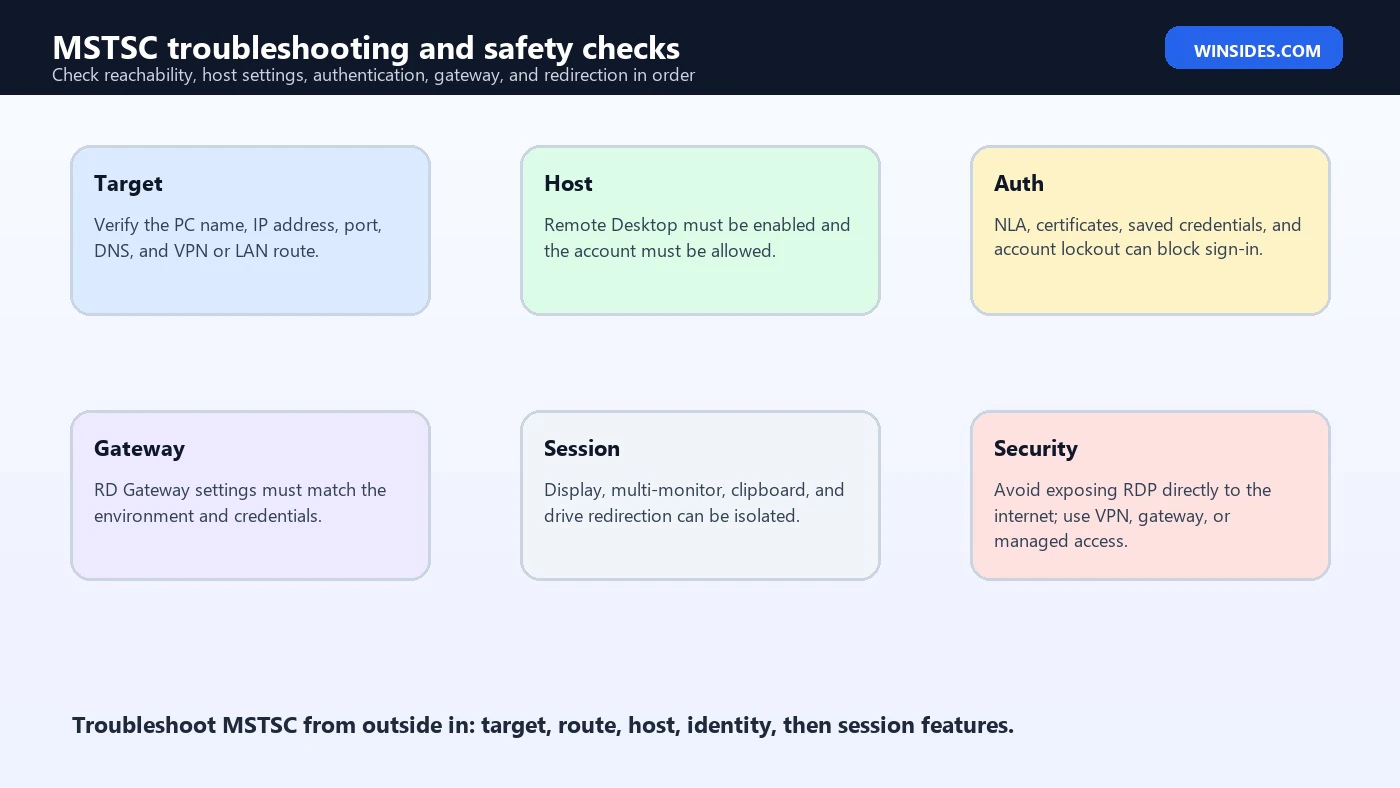
Troubleshoot MSTSC from outside in. First confirm the command is correct. Then confirm the target name, network path, Remote Desktop host settings, user permission, authentication, certificate trust, gateway, and redirection settings. A Remote Desktop error is often accurate but incomplete; it may tell you the connection failed without naming the exact layer.
| Symptom | Likely layer | What to check |
|---|---|---|
| Remote computer cannot be found | Name resolution or target typo | Check the computer name, FQDN, IP address, VPN, and DNS. |
| Cannot connect to remote computer | Network or host availability | Confirm the PC is on, reachable, Remote Desktop is enabled, and firewall allows it. |
| Credentials rejected | Identity or policy | Check username format, password, account lockout, domain, and Remote Desktop Users membership. |
| Certificate warning | Host identity | Verify the host name and certificate before continuing. |
| Gateway error | RD Gateway path | Check gateway name, certificate, policy, credentials, and network route. |
| Clipboard or drives missing | Redirection settings | Edit the RDP file or local resources settings. |
| Multi-monitor wrong | Display configuration | Use mstsc /l, test single monitor, then try /multimon. |
Do not change many things at once. If you switch networks, edit the RDP file, change credentials, and add a gateway at the same time, you will not know which change mattered. Test one layer at a time.
Security Best Practices
Remote Desktop is powerful because it gives interactive access to another computer. That also makes it a high-value target. Avoid exposing RDP directly to the internet. Use VPN, RD Gateway, managed remote access, conditional access, firewall rules, strong authentication, and account policies appropriate to the environment. For business systems, follow the organization’s remote access design rather than improvising public port forwarding.
Saved credentials should be handled carefully. They are convenient but can hide which account is being tested. When troubleshooting account problems, use /prompt or clear saved credentials so you know exactly which identity is used. On shared computers, use /public and avoid saving credentials or RDP files with sensitive targets.
Also pay attention to resource redirection. Clipboard, drive, printer, smart card, and audio redirection can be useful, but they also move data between local and remote environments. In a sensitive environment, only enable what the session needs.
Useful MSTSC Examples
mstscLaunches the Remote Desktop Connection window with no target specified.
mstsc /v:PC-OfficeConnects to a remote computer named PC-Office.
mstsc /v:server01.contoso.com /fConnects to a server in full-screen mode.
mstsc /v:server01 /w:1600 /h:900Starts a remote session with a specific window size.
mstsc /v:server01 /g:rdgateway.contoso.com /promptConnects through an RD Gateway and prompts for credentials.
mstsc /edit "C:\Users\Public\Desktop\OfficePC.rdp"Opens a saved RDP file for editing instead of connecting immediately.
RDP File Hygiene
Saved RDP files are useful, but they should be maintained. Use descriptive filenames, avoid storing them in public locations when they point to sensitive systems, and periodically remove old files. If a connection starts behaving unexpectedly, compare the saved file with a fresh connection. Old RDP files can preserve display, gateway, printer, drive, or credential behavior that no longer fits.
If you distribute RDP files to users, keep them simple. Include the correct target and gateway settings, but avoid unnecessary redirection. Explain which account format should be used. If a file must be retired, remove it from shared locations so users do not keep launching stale settings.
Saved Credentials and Credential Testing
Saved credentials are convenient, but they can make troubleshooting confusing. If MSTSC keeps failing with an account you did not intend to use, Windows may be reusing stored credentials. When testing access, use /prompt, remove saved credentials from the Remote Desktop Connection prompt, or check Credential Manager so the sign-in attempt is clear.
Use the correct username format for the environment. A local account may need PCName\User. A domain account may need DOMAIN\User or a user principal name such as user@contoso.com. A Microsoft account sign-in may behave differently depending on how the remote PC is configured. The right format matters as much as the password.
If a password was recently changed, the remote PC may reject old saved credentials even though the connection target is correct. If an account is locked, disabled, missing Remote Desktop permission, blocked by policy, or not allowed through Network Level Authentication, MSTSC cannot solve that with a display switch. Treat credentials as their own troubleshooting layer.
Local Resource Redirection
Remote Desktop can redirect local resources such as clipboard, printers, drives, smart cards, audio, and sometimes USB-related devices depending on policy and client configuration. These settings live mostly in the graphical client and saved RDP files rather than simple command-line switches. They matter because a connection can succeed while clipboard, printers, or drive access fail.
If clipboard copy and paste does not work, check the Local Resources tab in the RDP file and confirm policy does not block clipboard redirection. If local drives do not appear, check More under Local devices and resources. If printers behave strangely, test with printer redirection disabled to isolate whether the connection problem is actually a redirected printer problem.
Security-sensitive environments often disable drive or clipboard redirection. That is not a client bug. It may be deliberate policy to prevent data moving between local and remote machines. When working on business systems, ask whether redirection is allowed before spending time trying to force it from the client side.
Certificates and Identity Warnings
When MSTSC connects, it may warn that the identity of the remote computer cannot be verified. Do not train yourself to click through this automatically. The certificate warning is asking whether the host you reached is the host you intended to reach. On a trusted internal network, a self-signed or internal certificate may be expected. On an unfamiliar network, the warning deserves more attention.
Check the computer name, gateway, VPN, and certificate details. If the name in the certificate does not match the name you used, decide whether that mismatch is expected. If you connect by IP address, name matching can be harder. In managed environments, certificate configuration should be part of the Remote Desktop Services design, not a warning that users ignore forever.
Certificate warnings can also appear after a computer is rebuilt, renamed, cloned, or rejoined to a domain. If a warning appears suddenly for a system that used to connect cleanly, verify the change history before trusting the session.
Event Logs and Host-Side Clues
Client-side errors are only half the story. If you administer the remote host, check Event Viewer for Remote Desktop Services, TerminalServices, security logon events, firewall events, and account lockout clues. A host-side event can tell you whether the connection reached the machine, whether authentication failed, or whether the session was rejected by policy.
This is especially useful when the client message is vague. A generic connection failure might be network reachability. A credential prompt loop might be account format or NLA policy. A black screen after sign-in might be session initialization, display driver, profile loading, or host resource pressure. The host event logs help separate those cases.
For users who do not administer the remote host, collect the time of the failed connection, the exact target used, the account format, whether a gateway was involved, and the error text. Those details let the administrator correlate your attempt with server-side logs.
Quick Pre-Connection Checklist
- Confirm the remote PC is powered on and reachable on the network.
- Confirm Remote Desktop is enabled on the host edition and policy allows access.
- Confirm the user account is allowed to sign in through Remote Desktop.
- Confirm the target name, FQDN, IP address, and optional port are correct.
- Confirm VPN or RD Gateway is connected when required.
- Use
/promptwhen testing credentials instead of relying on saved entries. - Start with one monitor and basic redirection, then add display and device options later.
- Avoid exposing RDP directly to the internet; use an approved access path.
A checklist keeps MSTSC troubleshooting calm. The client is often blamed because it is the visible tool, but many failures live on the network, gateway, account, policy, or host side. Confirming the basics prevents unnecessary command-line experiments.
Using MSTSC in Shortcuts and Scripts
MSTSC is often launched from shortcuts, batch files, documentation snippets, and support runbooks. That is useful, but keep the command readable. A shortcut named Office PC with mstsc /v:PC-Office /f is easy to understand. A shortcut with many switches and no explanation becomes hard to troubleshoot later.
For repeatable support commands, prefer clear targets and minimal switches. Start with /v, then add display options only if they are required. Add /prompt when testing credentials. Add /g only when the connection must go through a specific RD Gateway. Avoid stacking special security or shadowing switches unless the runbook explains why they are needed.
mstsc /v:PC-Office /prompt
mstsc /v:server01.contoso.com /g:rdgateway.contoso.com /w:1600 /h:900
If the shortcut opens a saved RDP file, keep the file next to the runbook or in a predictable location. If the file changes, update the documentation. A shortcut can look unchanged while the RDP file behind it has a different gateway, redirection setting, or target computer.
Client Settings vs Host Configuration
A common MSTSC troubleshooting mistake is trying to fix host configuration with client switches. MSTSC can choose a target, display size, gateway, credential prompt, admin mode, or RDP file. It cannot turn on Remote Desktop on the remote PC, add a user to the allowed list, repair a firewall rule, approve a gateway policy, or unlock a disabled account.
When a connection fails, ask whether the issue belongs to the client or the host. Client-side issues include wrong target text, stale RDP files, saved credentials, display settings, and redirection choices. Host-side issues include Remote Desktop being disabled, Windows edition limitations, firewall rules, account permission, Network Level Authentication policy, and service availability.
This separation saves time. If every user fails to reach the host, look at the host, network, gateway, or firewall. If only one user fails, check that user’s permissions, credentials, saved RDP file, and account state. If only one client device fails, check local network path, cached credentials, display settings, and client policy.
Default.rdp and Resetting Stale Settings
Remote Desktop Connection can remember settings between sessions, including display choices and local resource preferences. If MSTSC behaves strangely even before you open a saved connection file, the default saved settings may be involved. Compare the behavior with a newly created connection and review saved settings before assuming the remote host is broken.
When troubleshooting, document whether the issue happens with a saved RDP file, a plain mstsc /v:target command, or the graphical client after manually typing the target. That distinction helps separate stale client settings from host or network problems.
Frequently Asked Questions
What is MSTSC used for?
MSTSC launches the classic Remote Desktop Connection client in Windows and can connect to remote computers, open RDP files, edit RDP files, and apply command-line options.
Does MSTSC work on Windows 11?
Yes. MSTSC is available on Windows 11 as the classic Remote Desktop Connection command.
How do I open MSTSC?
Press Win+R, type mstsc, and press Enter, or run mstsc from Command Prompt, PowerShell, or Windows Terminal.
What does mstsc /v do?
The /v switch specifies the remote computer or server to connect to, optionally including a port.
What is mstsc /admin?
The /admin switch connects to a session for administering a server. It does not bypass permissions or make a user an administrator.
What is an RDP file?
An RDP file stores Remote Desktop Connection settings such as target, display, gateway, and resource redirection options.
Is MSTSC safe to expose to the internet?
Directly exposing RDP to the internet is risky. Use VPN, RD Gateway, managed remote access, firewall restrictions, and strong authentication instead.
Conclusion: Use MSTSC as a Precise Remote Desktop Launcher
MSTSC is the classic Windows Remote Desktop Connection command. It can launch a normal connection, open a saved RDP file, edit a connection file, set display behavior, use RD Gateway, request credentials, connect in admin scenarios, and support specialized session options such as shadowing. The command is simple, but the connection path is not always simple.
Use MSTSC deliberately. Start with the target, then add only the switches you need. Keep RDP files clean, test display and redirection settings separately, avoid saving credentials on shared computers, and treat Remote Desktop exposure as a security design issue rather than a port-forwarding convenience.
For official reference, keep Microsoft pages for MSTSC, connecting to Remote Desktop Services, the Remote Desktop Services overview, and planning access from anywhere nearby while building or troubleshooting remote desktop access.
For more interesting articles, stay tuned to Winsides.com!





Community
Comments (0)