

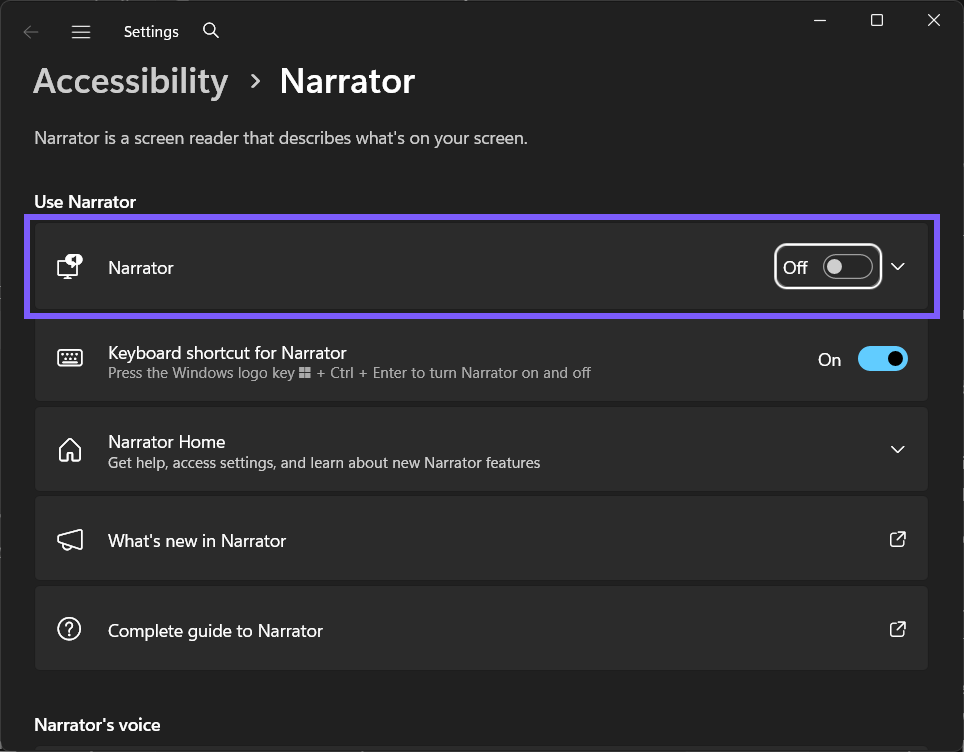
Narrator key is a focused Windows 11 accessibility preference under Settings > Accessibility > Narrator > Mouse and keyboard. It chooses whether Caps Lock, Insert, or both can act as the modifier in Narrator commands. The reproduced PC began at Caps Lock or Insert, moved temporarily to Insert, and returned to Caps Lock or Insert.
This guide uses the supported Settings interface, exact UI read-back, and a fresh rollback frame. No administrator approval, Registry edit, sign-out, package installation, personal document, or unrelated Windows change was needed. Narrator itself remained Off throughout the reproduction. That prevented unexpected speech, extension activity, startup behavior, or submission of visible content while the preference was being compared.
What does Narrator key change?
Chooses whether caps lock, insert, or both can act as the modifier in narrator commands. The Narrator key is a placeholder used inside Narrator commands. It does not change the global Windows logo key + Ctrl + Enter start shortcut, and it does not remap Caps Lock or Insert for every application.
Choose both for flexibility, or one key when the other conflicts with typing, a compact keyboard, or an assistive workflow.
Microsoft Support documents the current Narrator choices and their Windows Settings location. The official scope matches the labels reproduced on this Windows 11 25H2 PC, so there is no reason to substitute an old Control Panel label, a third-party accessibility utility, or an unsupported Registry value.
Microsoft Support supplies the current command reference. It is used here to define the keyboard boundary, not as a duplicate citation for the Settings route.
Table of contents
What should you record before changing it?
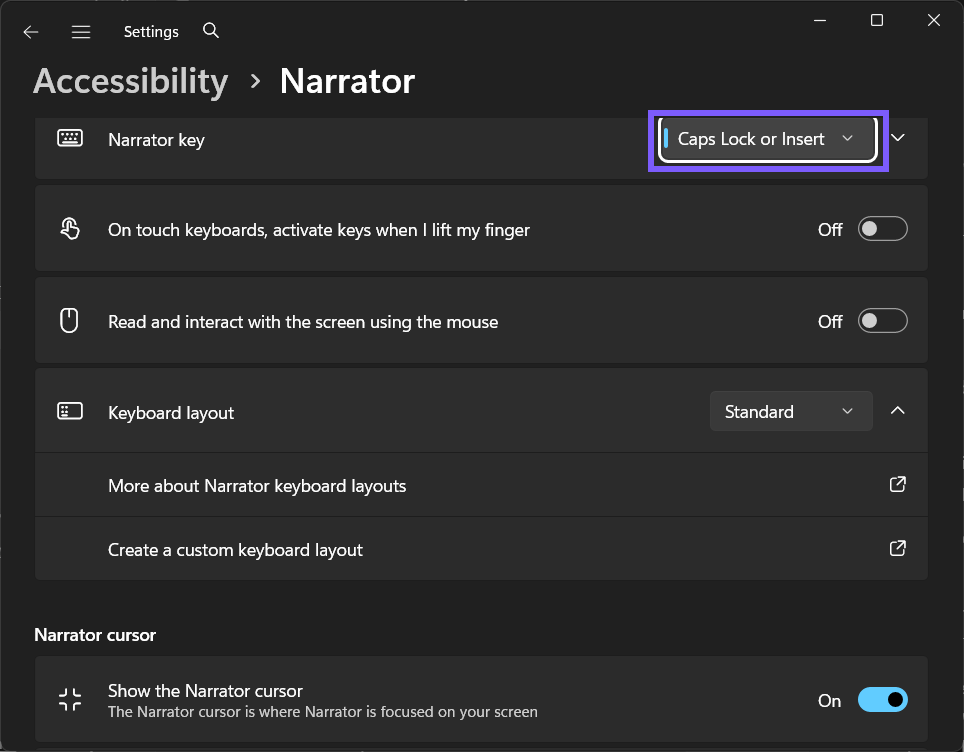
Open the target page and write down every value you intend to touch. The baseline in this session was Caps Lock or Insert. Windows applies these accessibility preferences directly, so that note is the rollback reference; there is no separate Apply button to preserve an uncommitted state.
Read the entire label before selecting the switch, checkbox, menu, or slider. The page contains closely related startup, voice, Home, extension, keyboard, and data-service controls. Changing a sibling at the same time would make the result ambiguous and could create behavior that this guide never tested.
Close email, passwords, customer material, notifications, and personal documents. A screen reader or magnifier can make content more noticeable to people nearby, and connected Narrator services can have a data boundary. A privacy-safe Settings page is sufficient for the evidence below.
How do you change Narrator key?
Press Windows logo key + I to open Settings.
Select Accessibility, then select Narrator.
Follow Settings > Accessibility > Narrator > Mouse and keyboard. Expand Show more settings or the named group when the control is not visible immediately.
Locate Narrator key and confirm the recorded starting value. On the reproduced PC, it was Caps Lock or Insert.
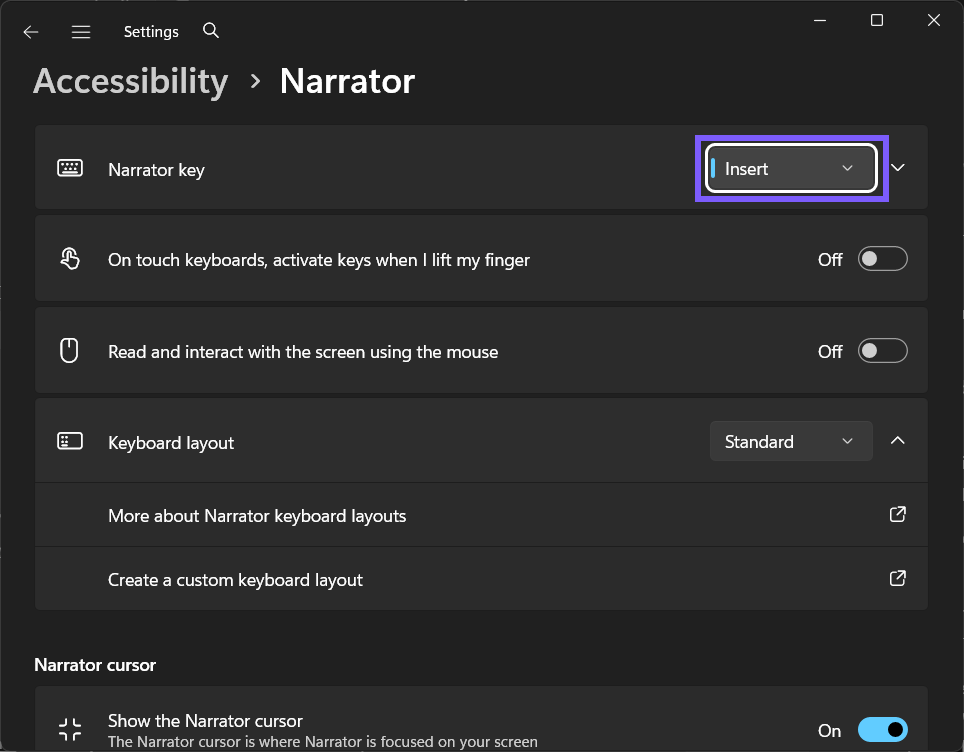
For the controlled comparison, open Narrator key and choose Insert. On your own PC, choose only the value that matches the behavior you want.
Microsoft Support provides the broader Narrator guide or behavior boundary. Use the supported Settings route and documented commands instead of downloading an unrelated tool or changing several accessibility defaults together.
How can you verify the preference safely?
Narrator remained Off. The menu changed from Caps Lock or Insert to Insert and then returned, so no Narrator command or ordinary key action was invoked.
First, read the exact control again and confirm Insert. That read-back proves that the preference was stored. It is more precise than guessing from a sound, window, network request, or sign-in behavior that can have several causes.
Do not broaden the test merely to make it dramatic. A later-session startup choice can be validated as a checkbox without ending the current session; a connected service can be validated as a switch without submitting an image; and a Narrator preference can be validated without speaking private text.
Microsoft notes a different default for Japanese 106 keyboards. Laptop layouts and remote sessions can also make Insert inconvenient or unavailable.
What did the reproduced comparison show?
The Narrator key menu accepted Insert and restored Caps Lock or Insert without changing the global shortcut or starting Narrator.
The evidence is intentionally narrow. It proves the exact Windows Settings transition on the tested PC and the absence of a prompt or forced restart. It does not claim that every language, keyboard, voice package, managed device, remote session, Store state, or protected screen presents identical surrounding behavior.
How do you restore the original value?
Return to Settings > Accessibility > Narrator > Mouse and keyboard, locate Narrator key, and choose Caps Lock or Insert again. Re-read the control and confirm Caps Lock or Insert before closing Settings.
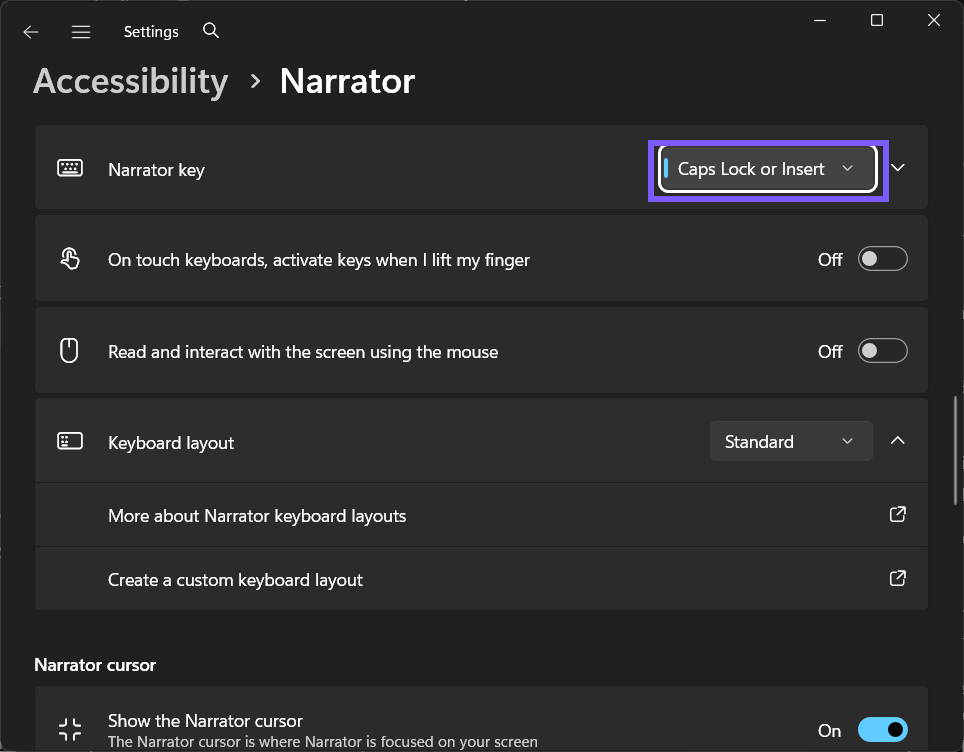
The final image is a fresh post-rollback frame rather than a copy of the baseline. It shows the restored value in a slightly different page position. Settings, Narrator, ShareX, and all preview tools were closed after the read-back.
How is this different from nearby Narrator controls?
The Narrator key is a placeholder used inside Narrator commands. It does not change the global Windows logo key + Ctrl + Enter start shortcut, and it does not remap Caps Lock or Insert for every application.
Treat the label as a scope boundary. A startup checkbox is not the master On/Off switch; an extension-download choice is not an extension-uninstall command; a Home-window option is not speech; and a voice characteristic is not the Windows system volume. Return to the parent page when the symptom belongs to a different owner.
When troubleshooting, change one preference, observe one result, and restore it before moving on. That sequence makes a comparison repeatable and avoids accidentally leaving a second accessibility behavior enabled.
What are the privacy and safety boundaries?
Narrator itself remained Off throughout the reproduction. That prevented unexpected speech, extension activity, startup behavior, or submission of visible content while the preference was being compared.
No retained frame contains an account identifier, notification, credential, device name, or personal file. The only temporary mutation was the named standard-user preference. The test did not install or remove a voice or extension, open Outlook or Excel, request an online description, lock the PC, or sign out.
If you intentionally test spoken or connected behavior later, use a disposable local sentence or nonprivate image and stop speech with Ctrl when necessary. Review the Microsoft privacy information before sending content through a connected service.
Common problems and careful checks
What does “Narrator” mean in a keyboard command?
It means whichever modifier is selected here—Caps Lock, Insert, or either key when both are enabled.
Does choosing Insert disable Caps Lock normally?
No. This menu defines Narrator commands; it does not remove ordinary capitalization behavior.
Why is Insert difficult to use on a laptop?
Some compact keyboards place Insert behind a function layer. Choose the option that is physically practical.
Is the Narrator key the same as the startup shortcut?
No. Windows logo key + Ctrl + Enter is the separate global start/stop chord.
Does this require administrator rights or a restart?
No administrator rights, sign-out, or restart were required for the reproduced Settings transition. A future-session startup behavior naturally waits for that later session, but the checkbox itself changed and rolled back immediately.
A managed work or school PC can lock an accessibility preference. When the control is unavailable or reverts because of policy, ask the administrator rather than attempting to bypass management with a script, policy edit, or Registry change.
Related Narrator and accessibility choices
If you are building a broader accessibility workflow, you can review useful Windows 11 keyboard shortcuts. For a different but related need, see how to set up a braille display for Narrator. Both are already-live WinSides guides; this article does not link to any future rotation sibling.
Frequently Asked Questions
Where is Narrator key in Windows 11?
Open Settings > Accessibility > Narrator > Mouse and keyboard, expand the relevant group, and use the exact control shown in the screenshots.
Can you verify this preference without exposing private content?
Yes. Read the exact Settings value. The reproduced session kept the feature inactive where appropriate and used no personal document, account surface, or connected-content request.
Can you restore the original value after testing?
Yes. Return to the same control, restore Caps Lock or Insert, and read every affected value back. A fresh final frame proves the rollback.
Do you need a Registry edit or restart for this setting?
No. The supported per-user Settings control changed and rolled back without Registry Editor, elevation, or a restart on the reproduced Windows 11 PC.
Conclusion
Open Settings > Accessibility > Narrator > Mouse and keyboard, record the starting value, and change only Narrator key. Verify the exact read-back with privacy-safe content, respect the setting's scope, and restore Caps Lock or Insert whenever the change was only a test.
For more interesting articles, stay tuned to WinSides.com!




Community
Comments (0)