

Auto Shutdown in Windows 11: In Windows 11, setting up an automatic shutdown can be a convenient way to ensure your system powers off at a specific time, whether to save energy, enhance security, or maintain a regular schedule. Using Task Scheduler, you can automate the shutdown process with just a few simple steps. This guide will walk you through the process of scheduling an automatic shutdown in Windows 11 for efficiency and effectiveness.
Table of contents
Auto Shutdown in Windows 11 – How can it be helpful?

Several ways can make the Auto Shutdown Feature or the Scheduled Shutdown Feature in Windows 11 really helpful.
- Auto Shutdown prevents computers from running unnecessarily, saving electricity and reducing energy costs, especially in large organizations or households.
- It ensures systems are powered off after updates or maintenance tasks, avoiding unnecessary running time and potential issues from prolonged uptime.
- It enhances security by ensuring that unattended computers are not left running, reducing the risk of unauthorized access or data breaches.
- It helps prevent overheating in environments where computers might be left running for extended periods, especially in areas with inadequate cooling.
- Parents can manage the amount of time children spend on computers by scheduling shutdowns at specific times, such as bedtime.
- Setting up an automatic shutdown in Windows 11 helps reduce your Carbon Footprint by minimizing unnecessary energy consumption and lowering greenhouse gas emissions.

Set up Auto Shutdown in Windows 11 using Task Scheduler
Without any further delay, let’s dive into the steps.
- Open the Run command and execute the following command.
taskschd.msc
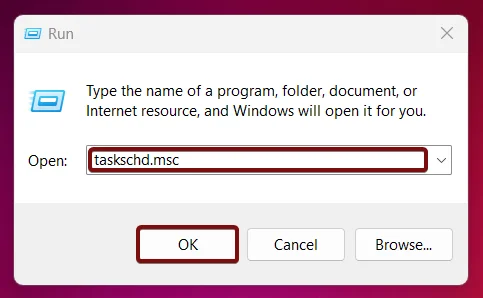
- Task Scheduler will open now.
- From the Right Pane, Click on Create Basic Task.
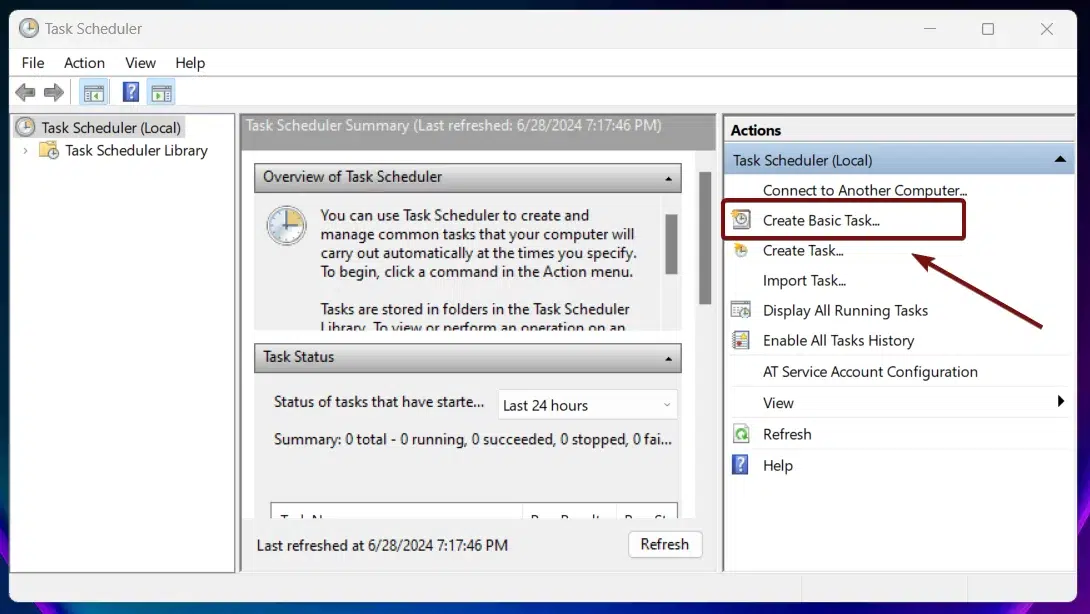
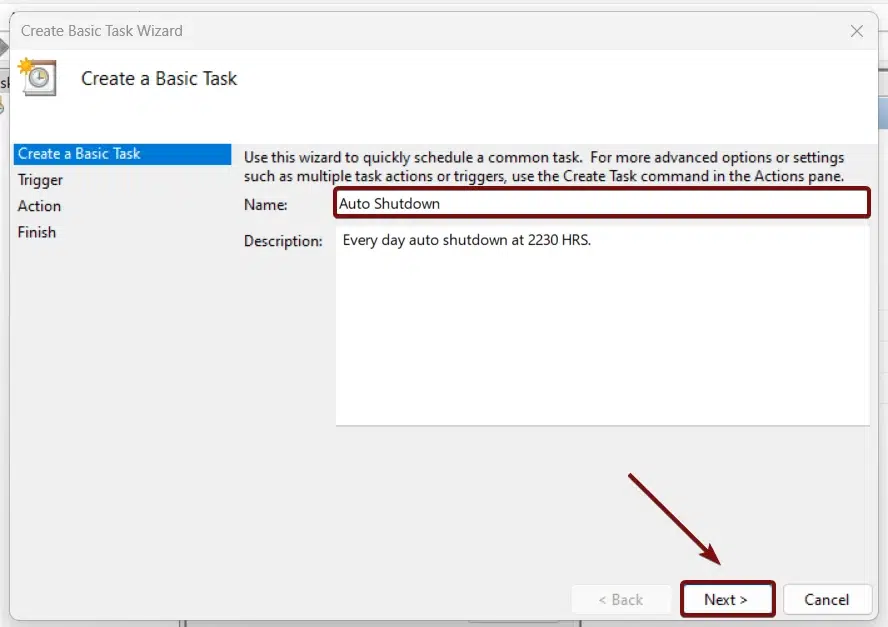
- Create Basic Task Wizard will open now.
- In the name field, please enter Auto Shutdown or a name that is convenient for you. The Description field is optional. You can describe this task in detail. Click Next.
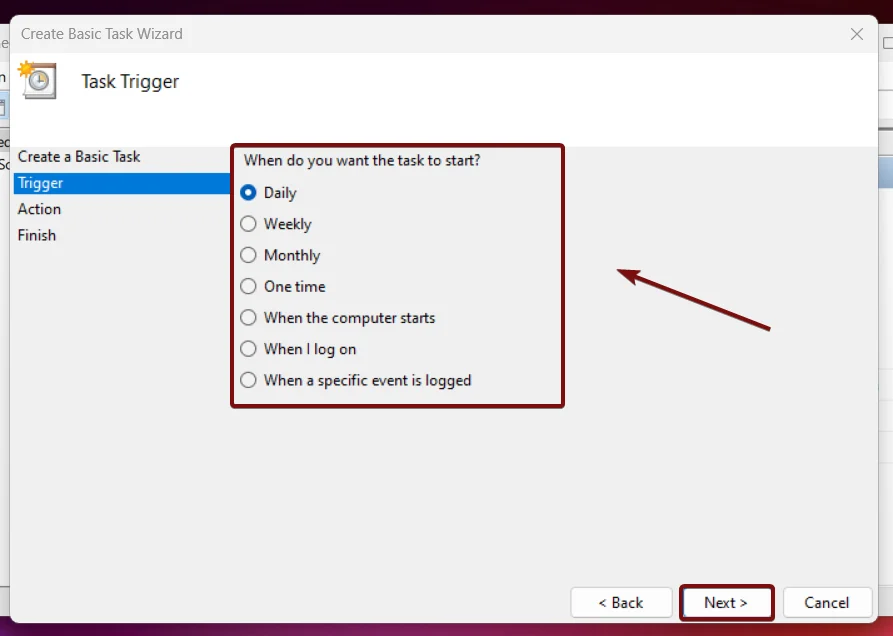
- Under Triggers, specify when you want to start the task. You can choose the Trigger for Daily, Weekly, Monthly, One time when the computer starts, When I log on, or When a specific event is logged. Choose the trigger as per your requirement. For explanatory purposes, I will choose Daily. Click Next.
- The next step is to specify the date and time. Specify the start date and the time when the Trigger has to be triggered. Since I am looking to schedule auto shutdown every day, I kept 1 in the Recur every day. The “Synchronize across time zones” option in Task Scheduler ensures that the scheduled task runs at the same local time, regardless of the time zone the computer is in. This can be beneficial for traveling users, cross-time zone coordination, and global operations. Click Next.
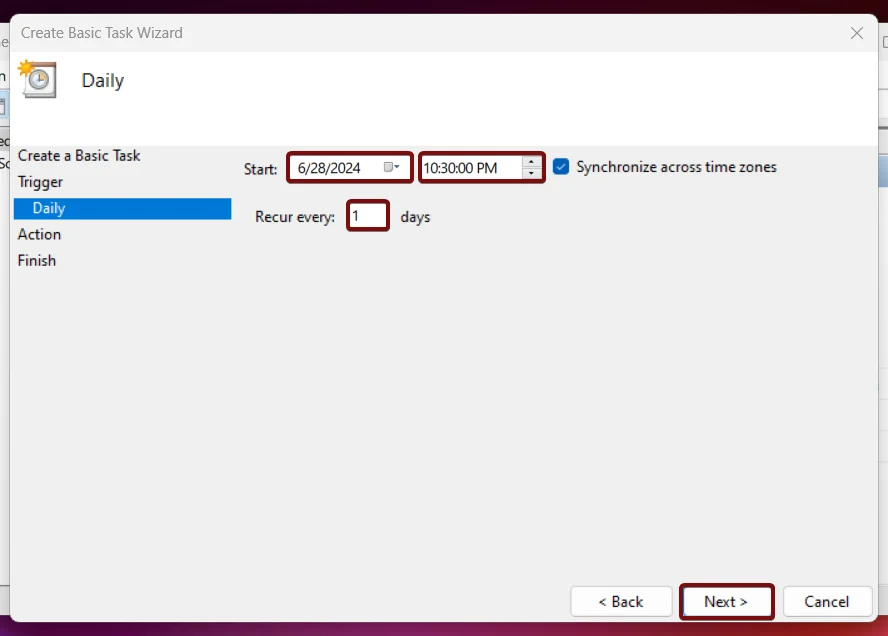
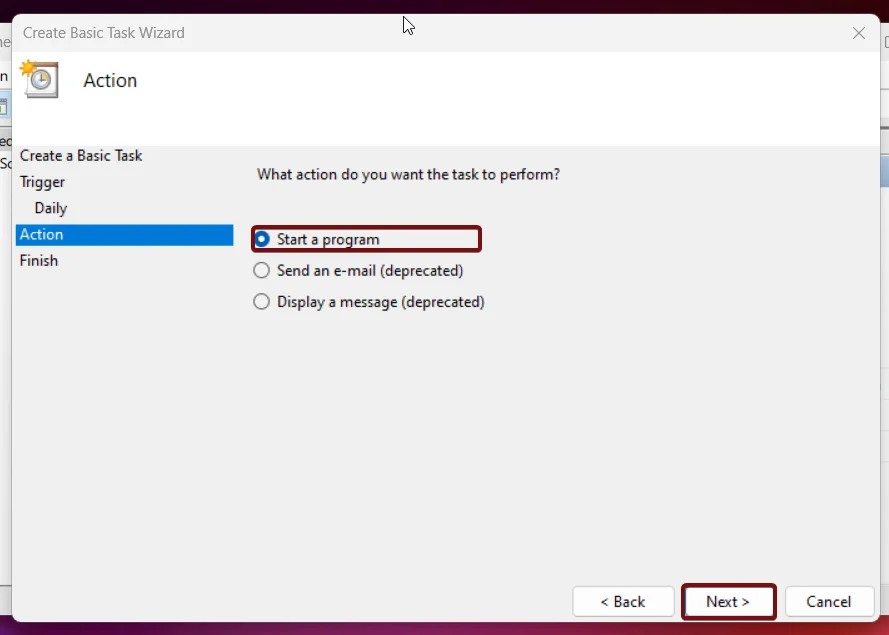
- Choose Start a Program as Action.
- In the Program/Script field, enter the following path.
C:\Windows\System32\shutdown.exe - Add Arguments is an optional field. Choose your arguments as per your requirements. It is recommended to add /s
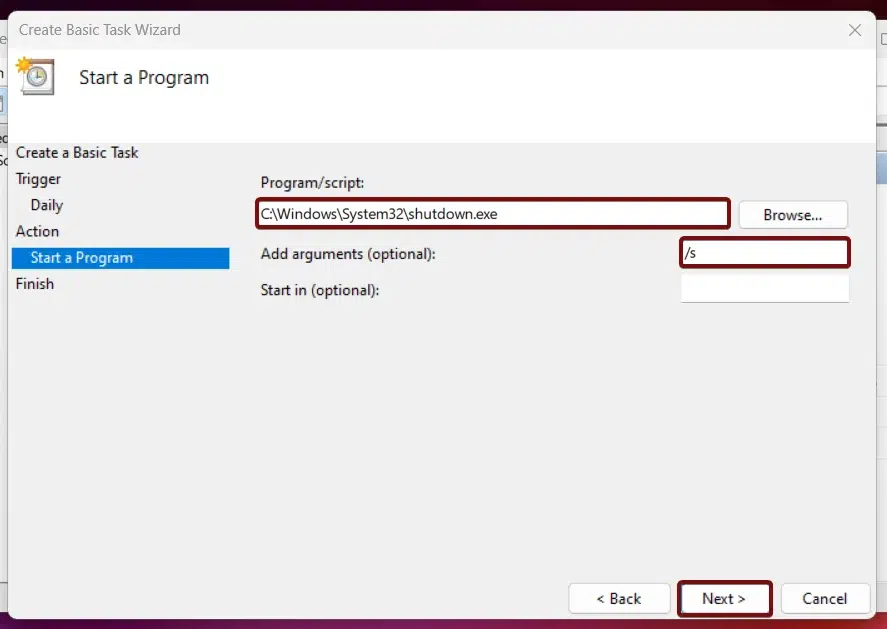
In the "Add arguments (optional)" field, type /s /f /t 0. This command forces a shutdown immediately (/s for shutdown, /f for force close applications, and /t 0 for zero seconds delay).
- Eventually, click Finish to complete the process. If you want to make any changes to the Triggers and actions, you can click Back.
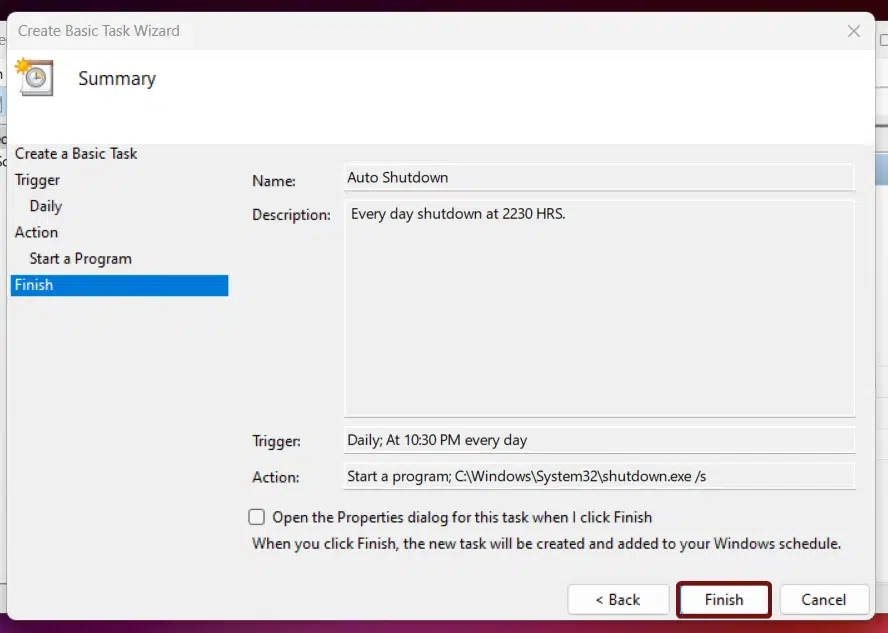
- Once you click Finish, the new task will be created and added to your Windows 11 Schedule.
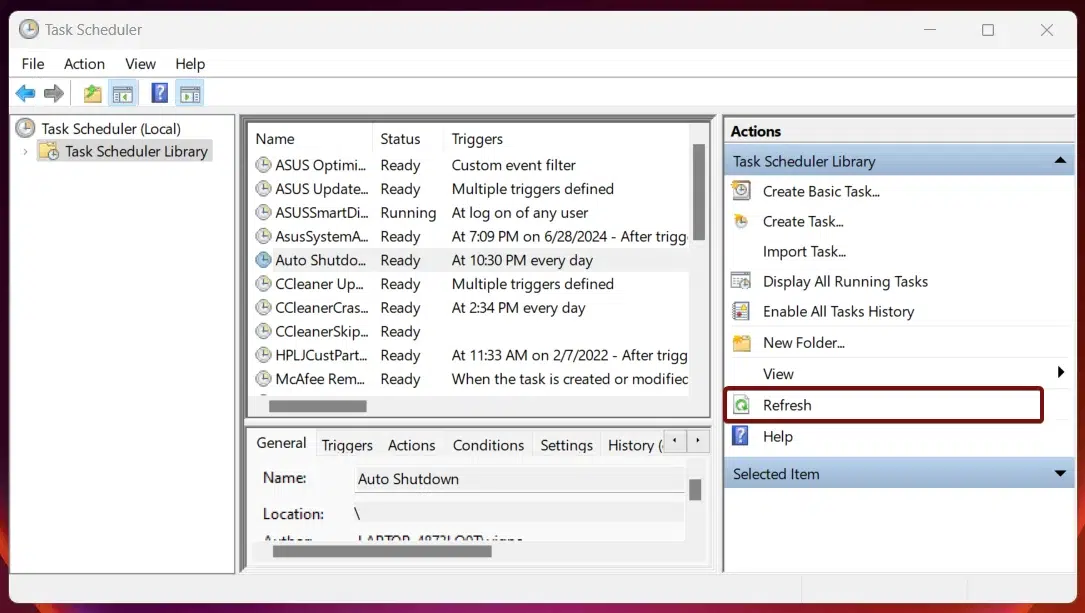
- Click on the Refresh option from the right pane to update the Task Scheduler.
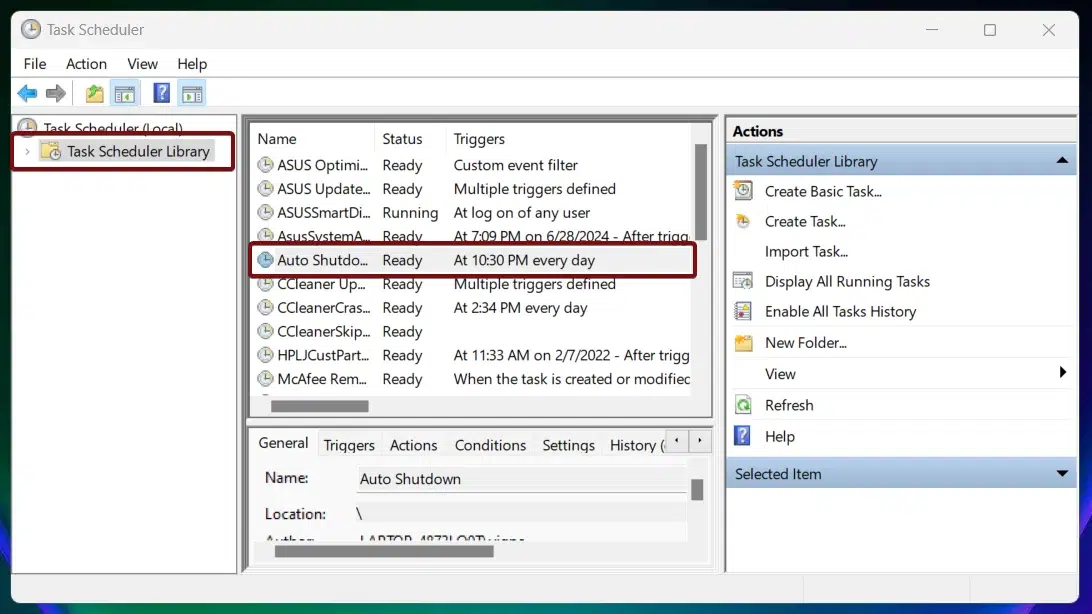
- Under the Task Scheduler Library, you can find the task created. That is it! We have now successfully set up Auto Shutdown in Windows 11.
Test the Auto Shutdown Process in Windows 11:
In this section, we will check out the steps to test the task that we have created in the Task Scheduler.
- Right-click on the Auto Shutdown Task that we have created, and click Run.
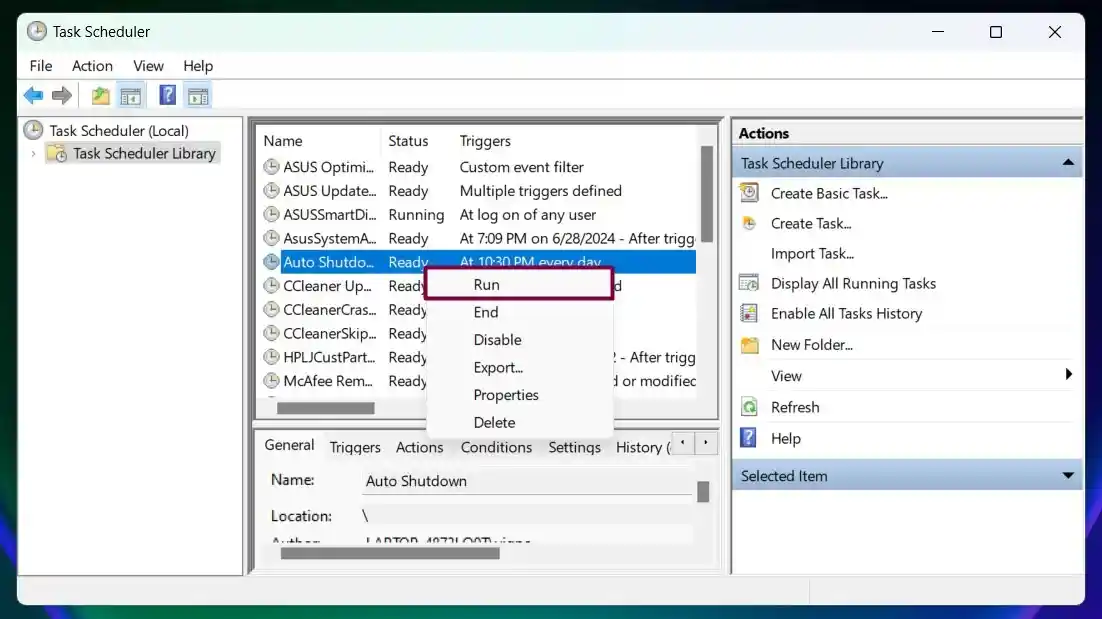
IMPORTANT: Running the above Task will shutdown the computer and hence, please make sure to save all your tasks to avoid data loss.
- The system will shut down if it is configured correctly. If not, please check the Arguments and Trigger values for corrections.
Frequently Asked Questions
Can I schedule a shutdown based on an “Idle” state?
If you want your PC to turn off only when you aren’t using it, you can modify a task in the Task Scheduler. Under the Conditions tab of your shutdown task, check the box for “Start the task only if the computer is idle for:” and set your preferred duration. This prevents the computer from shutting down while you are still in the middle of a project.
Why did my scheduled shutdown fail to trigger?
There are two common reasons for a failed auto-shutdown. Some programs (like unsaved Word docs or certain media players) may prompt “Do you want to save changes?” which blocks the shutdown. Using the -f (force) argument in your command usually bypasses this. If your PC enters “Sleep” mode before the scheduled shutdown time, the task may not trigger. Ensure your sleep timer is set to a longer duration than your shutdown timer.
Does Windows 11 have a “Sleep Timer” in the Settings app?
Windows 11 does not have a “shutdown timer” toggle in the main Settings menu yet. Currently, Settings only allows you to adjust when the screen turns off or when the PC goes to Sleep. For a full Shutdown, you must use the Command Line or Task Scheduler methods mentioned above.
Why does my PC restart instead of shutting down?
If you schedule a shutdown but the PC immediately turns back on, it is often due to a feature called “Wake on LAN” or a peripheral (like a mouse or keyboard) triggering a wake event. Go to Device Manager, right-click your Network Adapter and Mouse, go to Power Management, and uncheck “Allow this device to wake the computer.
Take away:
Task Scheduler in Windows is a powerful tool that allows users to automate various tasks on their computers. It enables the scheduling of programs, scripts, or commands to run at specific times or events. This includes tasks like system maintenance, software updates, backups, and more. Auto Shutdown in Windows 11 with Task Scheduler helps save energy, improve security, and solve the purpose as per your needs.
Have Queries?
We hope you are satisfied with our article, and if you have any queries, kindly let us know in the comments. Stay tuned to Winsides.com. Happy Windows 11! Peace out!









Community
Comments (2)