

Introduction to kb5083631 Windows 11
kb5083631 Windows 11 is the kind of update query where caution matters. A Windows KB number can refer to a cumulative update, preview update, out-of-band fix, servicing stack package, dynamic update, driver-related package, or support article. It can also be mistyped, regionally delayed, superseded, pulled, or discussed online before a Microsoft support page is easy to find. Because of that, the safe starting point is not to repeat a rumored changelog. The safe starting point is to verify the KB through Microsoft-controlled update channels.
At the time of writing this guide, direct search visibility for a Microsoft Support page dedicated to KB5083631 is not reliable enough to treat a third-party changelog as authoritative. That does not mean the KB is fake, and it does not mean every mention is wrong. It means the correct workflow is to confirm the update in Windows Update, Microsofts Windows 11 update history, Microsoft release information, or Microsoft Update Catalog before installing, troubleshooting, or recommending it.
Use Microsofts official Windows 11 release information page as the version and lifecycle reference: Windows 11 release information. Use Microsofts Windows 11 update history to match KB numbers to release notes when a support article is available: Windows 11 update history. Use the official Microsoft Update Catalog only when you need to manually verify or download a package: Microsoft Update Catalog. This article explains how to handle KB5083631 safely without guessing.
The guide is written for users who see KB5083631 in Windows Update, read about it online, find it in update history, or face an installation issue with that KB number. The goal is to show how to confirm whether it applies to your device, how to install it safely if Microsoft offers it, how to troubleshoot failure codes, how to uninstall it if it causes a problem, and how to avoid dangerous unofficial downloads.
Table of contents
Key Takeaways
- Verify KB5083631 before trusting it. Use Windows Update, Microsoft update history, or Microsoft Update Catalog rather than random download sites.
- Do not invent a changelog. If Microsofts dedicated KB page is not visible, treat details from non-Microsoft sources as unconfirmed.
- Match the Windows version. A KB may apply only to specific Windows 11 versions, builds, architectures, or release channels.
- Windows Update is the safest install path. Manual Catalog installs should be used only when the package clearly matches your device.
- Record the exact error code. Troubleshooting depends on whether the failure is download, install, servicing, storage, reboot, or rollback related.
- Uninstall only when needed. If the KB causes a confirmed regression, remove it from update history or recovery options and then pause updates briefly.
- Avoid fake MSU packages. Never install Windows updates from unofficial mirrors, compressed archives, scripts, or repackaged installers.
What a KB Number Means
KB stands for Knowledge Base. Windows update names often use a KB number to identify the support article or update package. In modern Windows 11 servicing, a single cumulative update can include security fixes, quality improvements, servicing fixes, previous improvements, and sometimes gradually rolling features. The KB number helps users, administrators, and support teams refer to the same update, but it is not enough by itself to prove applicability.
The same KB may appear differently depending on Windows version, release channel, architecture, and whether the device receives consumer Windows Update, Windows Update for Business, WSUS, Intune, Autopatch, or a manual Microsoft Update Catalog package. A Windows 11 Home PC may see an update at a different time from a business-managed laptop. A preview update may be optional. A security update may be automatic. A superseded update may stop appearing because a newer cumulative package replaced it.
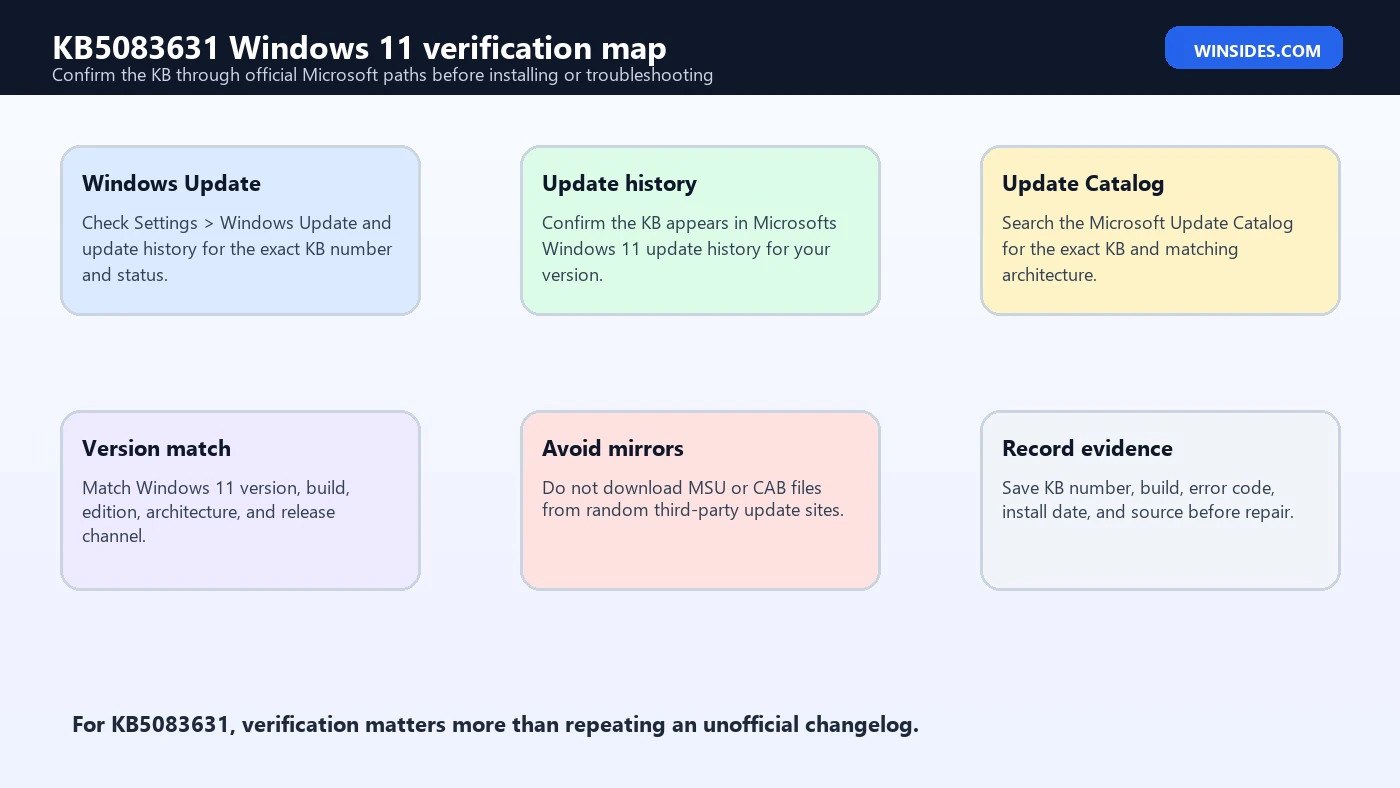
That is why KB5083631 should be handled as a verification task first. If the device shows the update in Settings, you have local evidence. If Microsoft update history lists the KB for your Windows 11 version, you have release-note evidence. If Microsoft Update Catalog lists a package with matching product, architecture, and date, you have package evidence. If you only have a random download link, you do not have enough evidence.
How to Verify KB5083631
- Open Windows Update. Go to Settings > Windows Update and check whether KB5083631 is offered to your device.
- Open Update history. In Settings > Windows Update > Update history, search visually for KB5083631 under quality updates or other update groups.
- Check your Windows version. Run
winverand record Windows 11 version, OS build, and edition. - Compare Microsoft update history. Look for KB5083631 in Microsofts Windows 11 update history for the same version/build family.
- Search Microsoft Update Catalog. Search the exact KB number and match architecture, product, classification, and last updated date.
- Reject unofficial downloads. If the package is not offered by Windows Update or Microsoft Update Catalog, do not install it.
The order matters. Windows Update knows your device state. Update history shows what installed or failed locally. The Microsoft support pages show the official release notes when published. Microsoft Update Catalog is useful for manual package verification, but it requires careful matching. A random website that hosts an MSU file is not an official validation path.
Check Windows Version and Build
Before installing or troubleshooting any KB, confirm the Windows version. Press Windows + R, type winver, and press Enter. Note the version, OS build, edition, and whether the device is on a consumer or managed update policy. A KB designed for one Windows 11 build family may not apply to another. If the device is on Windows 11 version 24H2, 25H2, 26H1, Insider, or a managed release ring, the update eligibility may differ.
You can also check Settings > System > About for edition, version, OS build, system type, and device specifications. System type matters for manual downloads because Microsoft Update Catalog can list x64, ARM64, dynamic updates, server-related packages, or other variants. Installing the wrong package should fail gracefully, but forcing mismatched update files is still a waste of time and can complicate troubleshooting.
winverSettings > System > About > Windows specificationsWindows Update vs Microsoft Update Catalog
| Path | Best use | Caution |
|---|---|---|
| Windows Update | Normal installation for home and unmanaged Windows 11 PCs. | The update may not appear if it is not applicable, not yet rolled out, paused, hidden by policy, or superseded. |
| Update history | Confirm whether KB5083631 installed, failed, or was removed. | History can show failed attempts even when a newer cumulative update later superseded the package. |
| Windows 11 update history | Read official release notes and known issues when Microsoft publishes the KB page. | If the exact KB is absent, avoid repeating unverified changelog claims. |
| Microsoft Update Catalog | Manual download for admins or advanced users who need the exact package. | You must match product, architecture, update type, and version; avoid third-party mirrors. |
| Managed update tools | WSUS, Intune, Windows Update for Business, Autopatch, or enterprise rings. | Policies may defer, approve, block, or supersede the KB. Coordinate with IT. |
Should You Install KB5083631 Manually
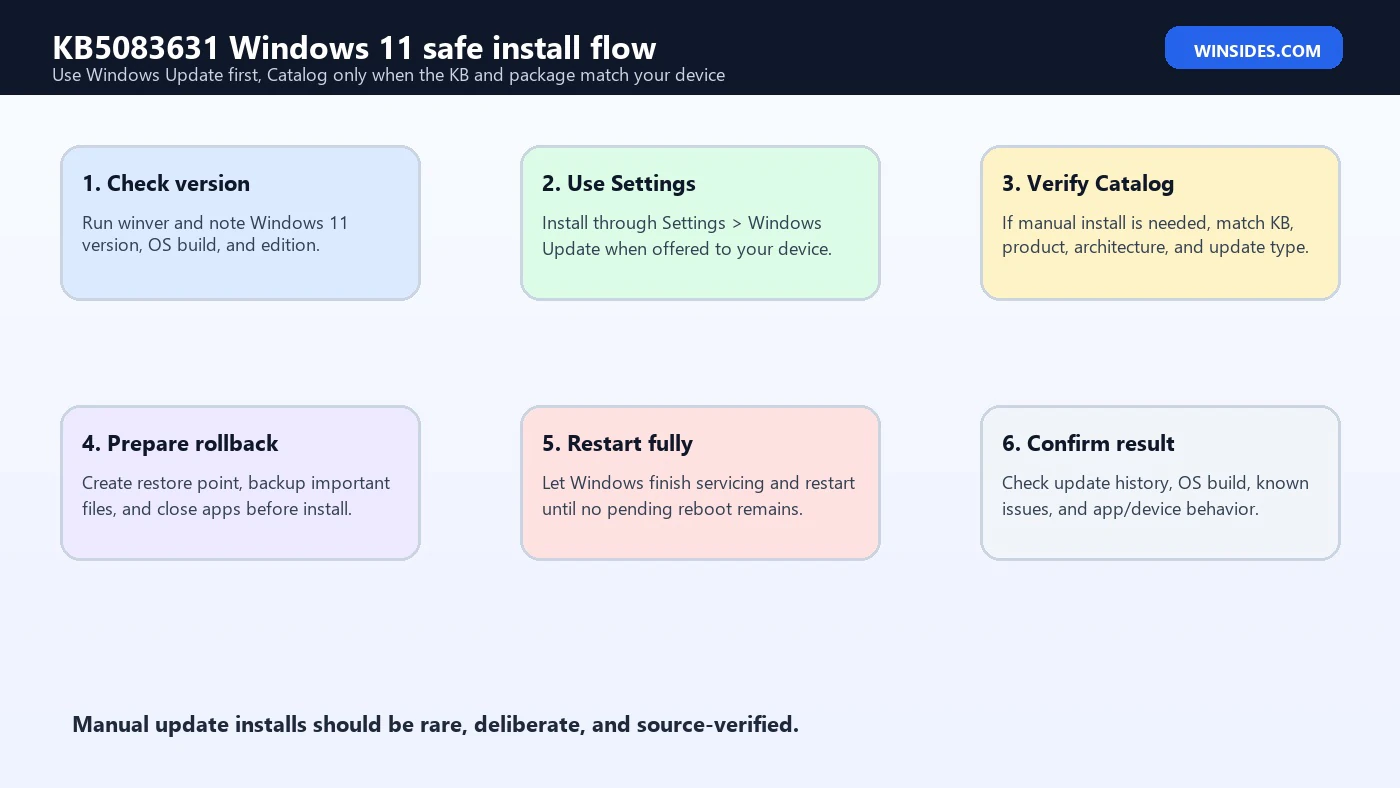
Manual installation should be the exception. If KB5083631 appears in Windows Update for your device, let Windows install it through the normal path. That route handles applicability checks, prerequisites, reboot orchestration, pending actions, and servicing integration. If the update does not appear, there may be a reason: staged rollout, safeguard hold, unsupported version, management policy, supersedence, or the KB simply not applying to your build.
Use Microsoft Update Catalog only when you can confirm that the package matches your device and you have a reason to install manually. Good reasons include offline deployment, enterprise testing, repair of a Windows Update client problem, or a Microsoft support instruction. Weak reasons include a forum saying the update is faster, a random site hosting an MSU, or a video claiming the KB unlocks hidden features. Windows servicing is cumulative; chasing individual preview packages without a reason can create confusion.
Before a manual install, close apps, save work, connect power, ensure enough disk space, and create a restore point or backup important files. Manual installs can still fail if the component store is unhealthy, the package is superseded, the device is pending reboot, or the architecture does not match. Treat the Catalog as an official source, not as a shortcut around normal applicability rules.
How to Install Safely If Offered
- Use Windows Update first. Open Settings > Windows Update and let Windows download and install the update.
- Keep power stable. Use AC power on laptops and avoid interrupting restart phases.
- Free storage. Keep enough space for download, staging, rollback, and servicing logs.
- Restart when prompted. Some cumulative updates need more than one visible restart stage.
- Return to Windows Update. Check whether another cumulative, servicing, or Defender update remains pending.
- Verify update history. Confirm the KB status and OS build after installation.
Do not judge the install while it is still in progress. Windows servicing can pause at percentages, restart several times, or finish background cleanup after sign-in. If the device is usable and Windows Update is not reporting failure, give the process time. If it fails, capture the exact error code before trying repairs.
Common Installation Failure Patterns
| Symptom | Likely area | First checks |
|---|---|---|
| Download stuck | Network, cache, VPN, proxy, metered connection, or Windows Update service. | Restart, check internet, disable temporary VPN, verify storage, retry later. |
| Install fails with code | Servicing stack, component store, disk space, supersedence, or corrupted payload. | Record code, run Windows Update troubleshooting, check DISM/SFC. |
| Undoing changes | Install or reboot phase failure. | Disconnect nonessential devices, free storage, update drivers, review recent errors. |
| KB not offered | Not applicable, staged rollout, safeguard hold, policy, version mismatch, or superseded update. | Check winver, release notes, update history, managed policy. |
| Catalog package not applicable | Wrong architecture, product, build, or superseded package. | Recheck x64/ARM64, Windows version, build family, and package details. |
| App or driver issue after install | Regression, compatibility issue, or driver conflict. | Update the app/driver, check known issues, uninstall KB if confirmed. |
Troubleshooting KB5083631 Failures
Start with evidence. Write down the exact KB number, Windows version, OS build, error code, date, whether the update came from Windows Update or Catalog, and what changed before the failure. Without the error code, update troubleshooting becomes guesswork. Error codes such as 0x800f081f, 0x80073712, 0x8024, 0x8007000d, or rollback messages point to different branches.
Restart once, then run Windows Update again. If the same failure repeats, check storage and network. Disable only temporary VPN or proxy layers you control, not business security tools. On a managed device, ask IT because policy may be intentionally holding, deferring, or replacing the update. If Windows Update itself is damaged, try Windows Update troubleshooting from Settings > System > Troubleshoot > Other troubleshooters.
For servicing health, DISM and SFC can help when component store corruption is suspected. These tools do not guarantee a fix for every KB, but they are safer than deleting random Windows folders. Run them from an elevated terminal, restart, and retry Windows Update. If DISM itself fails, follow the DISM-specific error rather than repeatedly forcing the same KB.
DISM /Online /Cleanup-Image /RestoreHealthsfc /scannow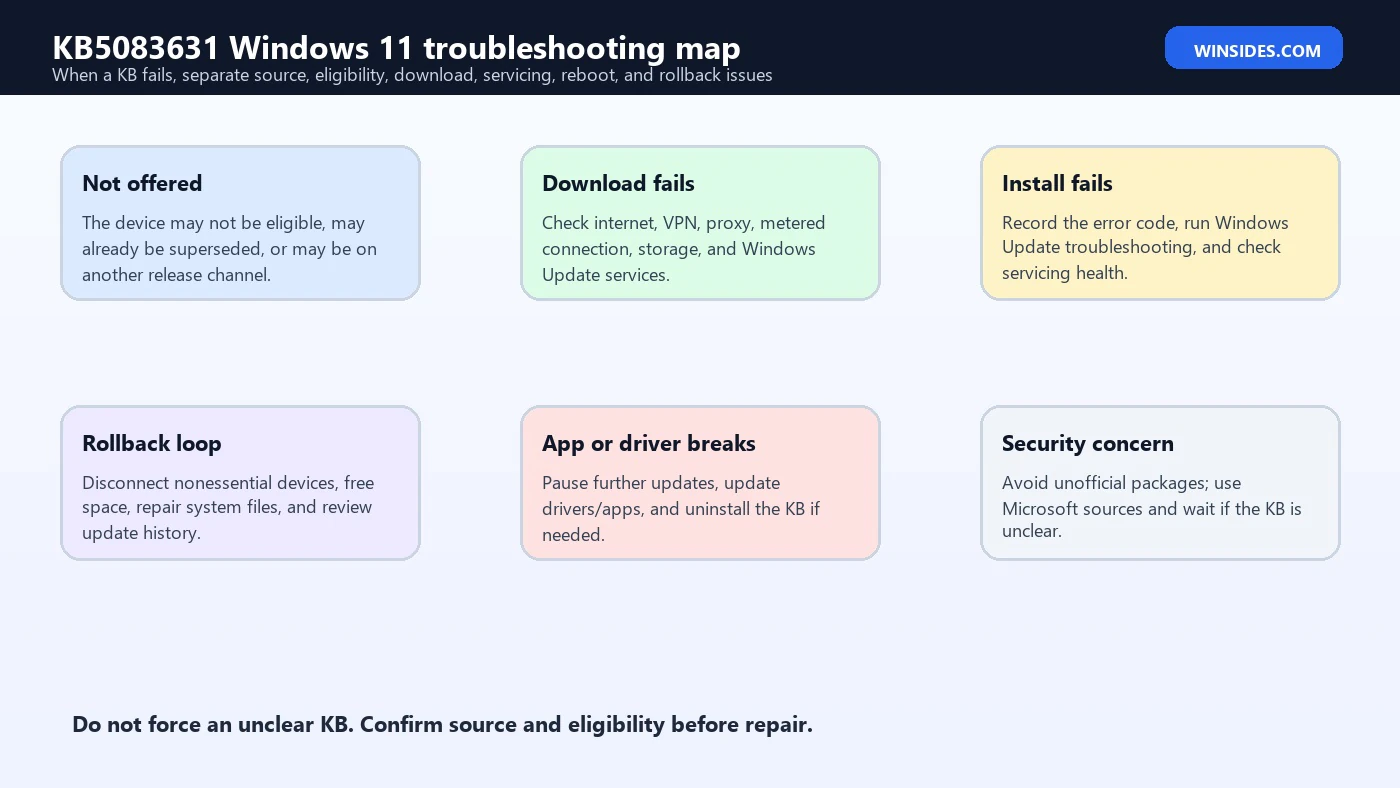
How to Uninstall KB5083631
Only uninstall a KB when you have a reason. A reason might be a confirmed app crash, driver failure, boot problem, performance regression, printing issue, VPN breakage, or device-specific problem that started immediately after the update and improves when the update is removed. Do not uninstall simply because a KB number appears online. Removing a cumulative update can also remove other fixes bundled in the same package.
Start in Settings > Windows Update > Update history > Uninstall updates. If KB5083631 appears there and Windows allows removal, select Uninstall and restart. If Windows cannot boot normally, use Windows Recovery Environment, uninstall latest quality update, or Safe Mode depending on the symptom. On managed devices, coordinate with IT because updates may reinstall automatically from policy.
After uninstalling, pause updates briefly only long enough to confirm the diagnosis, gather logs, update drivers or apps, and check Microsoft known issues. Do not leave the device unpatched indefinitely. If the issue is widely known, Microsoft may publish a known issue, compatibility hold, rollback, or later cumulative update that supersedes the problematic package.
Avoid Fake KB5083631 Downloads
Fake Windows update downloads are a real risk because users often search exact KB numbers when Windows Update fails. Attackers can publish pages that look technical, offer MSU or ZIP files, or include scripts that claim to fix a missing package. A real Windows update should come from Windows Update, Microsoft Update Catalog, Microsoft support links, WSUS, Intune, or another managed Microsoft-connected channel. It should not require a password-protected archive, unknown installer, browser extension, or command script from a random site.
Be especially cautious with pages that promise to unlock features, bypass eligibility, repair all Windows Update errors, or install preview packages on unsupported builds. A KB package is not a feature unlocker. It is a serviced Windows component package with strict applicability rules. If Microsoft Update Catalog does not list the package for your device, do not try to force a random file with the same number.
If you already downloaded an unofficial package, do not run it. Delete it, scan the system, and use official Microsoft channels. If you ran it and something changed, check installed programs, startup apps, scheduled tasks, browser extensions, Defender history, and Windows Security. For a work or school device, report it to IT immediately.
Managed and Enterprise Devices
On business, school, or enterprise PCs, KB5083631 may be controlled by Windows Update for Business, Intune, Autopatch, WSUS, Configuration Manager, or ring-based deployment. A user may not see the same update timing as a personal PC. The update may be deferred, approved for pilot devices only, paused by safeguard hold, replaced by a newer cumulative update, or bundled into a deployment schedule.
Do not manually install a Catalog package on a managed device unless IT instructs you to. Manual installation can bypass reporting, compliance, maintenance windows, and rollback planning. If the update fails on many devices, administrators should compare Windows build, policy ring, update source, error code, disk space, language pack state, driver baselines, and whether a newer cumulative update supersedes the package.
For IT teams, document the KB status by ring. Confirm whether KB5083631 is approved, declined, superseded, paused, or not applicable. Test in a pilot group before wide deployment, watch endpoint analytics, and prepare uninstall or pause guidance if a regression appears. Update troubleshooting at scale is an evidence problem, not a one-machine guessing game.
How to Match a Catalog Package Correctly
If you search Microsoft Update Catalog for KB5083631, do not click the first download button blindly. Read the product column, classification, architecture, last updated date, and package title. A package for Windows 11 x64 is not the same as one for ARM64. A dynamic update is not the same as a cumulative update. A server package or setup-related package may not be intended for a normal desktop install. The details matter because Windows servicing rejects mismatched packages, and repeated failed attempts waste time.
For most home users, the Catalog should be a verification tool rather than the normal install method. If Windows Update does not offer KB5083631, there may be a reason. Microsoft uses gradual rollout, safeguard holds, policy targeting, and cumulative supersedence. A newer cumulative update can include the same fixes while using a different KB number. In that case, forcing an older package is not only unnecessary; it may be impossible because the older package is no longer applicable.
If you are an administrator building an offline image or testing a deployment ring, document the exact Catalog package name, URL, file hash if available, architecture, target version, and test devices. Keep the package in a controlled software repository. Do not let users download update files independently from search results, because that breaks repeatability and introduces supply-chain risk.
Logs and Evidence for Stubborn Update Failures
When KB5083631 fails repeatedly, Windows logs matter more than guesses. Settings may show a short error code, but deeper detail can appear in Windows Update logs, Event Viewer, CBS logs, DISM output, and setup or servicing logs. Home users do not need to read every log line, but they should capture the visible error code, install timestamp, update source, and whether the failure happens before download, during install, during reboot, or after restart rollback.
Administrators can gather more detail. Event Viewer under WindowsUpdateClient can show detection, download, install, and failure events. CBS.log can show servicing stack details, although it is noisy. DISM may reveal component store corruption. If multiple PCs fail with the same code, compare device model, language packs, disk free space, drivers, management ring, third-party security tools, and whether a prerequisite or newer cumulative update is missing.
Avoid deleting SoftwareDistribution or catroot2 as a first move. Those resets can help in certain Windows Update cache problems, but they also erase useful history and should be done deliberately. Start with restart, retry, storage, network, Windows Update troubleshooting, DISM, SFC, and official update source verification. Use cache resets only when the symptom points to a corrupted local download or stuck update client.
After Installing KB5083631
- Check Update history. Confirm KB5083631 shows as successfully installed, if it is the package that Windows applied.
- Check winver. Record the OS build after installation and compare with Microsoft release notes if available.
- Test core workflows. Open File Explorer, browser, Microsoft Store, VPN, printing, audio, Bluetooth, and the apps you depend on.
- Watch reliability. Use Reliability Monitor if crashes or install errors appear after the update.
- Keep drivers current. Some update regressions are actually outdated driver or vendor utility conflicts.
- Do not panic over cleanup. Windows may continue background servicing after restart; give it time before judging performance.
Post-install testing should be boring and practical. You are not trying to find imaginary problems. You are confirming that the update installed, the system restarted cleanly, and your daily workflows still work. If something breaks, capture exactly what changed and when. That evidence will decide whether to update a driver, repair an app, wait for a known-issue notice, or uninstall the KB.
When Waiting Is the Correct Choice
If KB5083631 is an optional preview update, waiting can be the correct decision. Preview updates are often used to deliver non-security quality changes before the next security update cycle. They can be valuable for users affected by a specific bug, but they are not mandatory for every device. If your PC is stable and the KB is not offered automatically, you do not need to chase it unless Microsoft or your IT team identifies a reason.
If a KB is pulled, superseded, hidden by safeguard hold, or replaced by a later cumulative update, waiting is also correct. Windows servicing is cumulative. A later monthly update often includes earlier quality improvements plus additional fixes. Forcing an older update because it appears in a search result can put you behind the intended servicing path. Check official Microsoft pages and let Windows Update choose the applicable package.
For mission-critical PCs, avoid same-day optional update installs unless the update fixes a problem you actively have. Wait for early reports, review known issues, test on a noncritical device, and keep rollback options ready. This is not fear; it is normal change management. Updates are important, but stability and source verification matter too.
Safe Commands and Paths to Know
A few built-in commands help identify update state without installing anything from the web. winver shows the Windows version and build. Settings > Windows Update > Update history shows installed and failed updates. DISM and SFC can repair servicing health when corruption blocks updates. Event Viewer and Reliability Monitor can show patterns when update-related problems affect apps or drivers.
winverDISM /Online /Cleanup-Image /RestoreHealthsfc /scannowThese commands are not magic buttons. They are evidence and repair tools. Use them to understand the current state before deciding whether KB5083631 is applicable, failed, superseded, or unrelated to the symptom you are fixing. The more precise the evidence, the less likely you are to make the system worse while trying to help it.
How to Explain KB5083631 to Another User
If you support a family PC, a small office device, or a managed laptop, explain KB5083631 in plain operational terms. Say that it is an update identifier, not a guarantee that every article on the web has the correct details. The useful question is not simply whether the KB number exists; it is whether Microsoft is offering the update to that exact Windows 11 installation, whether the device meets the update requirements, and whether there is a real problem that needs manual action.
That wording matters because many update mistakes start with panic. Someone sees a KB number, assumes it is mandatory, downloads the first package they find, and then runs it on the wrong build. A better response is slower but safer: confirm the Windows version, check Windows Update, compare the Microsoft Update Catalog entry if needed, review the update history page, and document the result. This gives you a clean trail if the update installs, fails, disappears, or is later replaced by a newer cumulative update.
Frequently Asked Questions
What is KB5083631 on Windows 11?
Handle KB5083631 as a Windows update identifier that must be verified through Windows Update, Microsoft update history, or Microsoft Update Catalog before trusting details or installing packages.
Is KB5083631 safe to install?
It is only safe to install when Microsoft offers it through Windows Update or you confirm an official Microsoft Update Catalog package that matches your Windows 11 version and architecture.
Why can I not find KB5083631 in Windows Update?
The update may not apply to your version, may not be rolled out to your device, may be deferred by policy, may be hidden by a safeguard hold, or may have been superseded by a newer cumulative update.
Should I download KB5083631 from a third-party site?
No. Use Windows Update, Microsoft Update Catalog, or managed Microsoft-connected deployment tools. Avoid random mirrors, ZIP files, scripts, and repackaged MSU installers.
How do I check if KB5083631 installed?
Open Settings > Windows Update > Update history and look for the KB number. You can also compare winver build information with Microsoft update history when the official release note exists.
Can I uninstall KB5083631?
If it appears under uninstallable quality updates, you can remove it from Settings > Windows Update > Update history > Uninstall updates. Use this only for a confirmed regression and expect Windows to offer a later cumulative update afterward.
What if KB5083631 fails with an error code?
Record the exact code, restart, retry Windows Update, check storage and network, run Windows Update troubleshooting, then use DISM and SFC if servicing corruption is suspected.
What if Microsoft later publishes a KB5083631 page?
Use that Microsoft page as the authoritative changelog and known-issues source. Until then, avoid treating non-Microsoft summaries as official release notes.
Conclusion: Verify KB5083631 Before Acting
kb5083631 Windows 11 should be handled with a verification-first mindset. A KB number alone is not enough to prove that an update applies to your PC, that a changelog is official, or that a manual package is safe. Check Windows Update, local update history, Microsofts Windows 11 update history, Windows release information, and Microsoft Update Catalog before making install or uninstall decisions.
If Microsoft offers KB5083631 to your device, install it through Windows Update when possible. If you must install manually, use only Microsoft Update Catalog and match version, build, architecture, and package type. If the update fails, record the exact error code and troubleshoot the relevant branch: network, storage, component store, reboot, driver, policy, or applicability.
Most importantly, do not chase unofficial MSU files or scripted repair packs. Windows cumulative updates are sensitive system packages. The safe route is official source verification, careful installation, evidence-based troubleshooting, and rollback only when a confirmed regression requires it.
For more interesting articles, stay tuned to Winsides.com!








Community
Comments (0)