

Introduction to Use Setup Script Windows 11
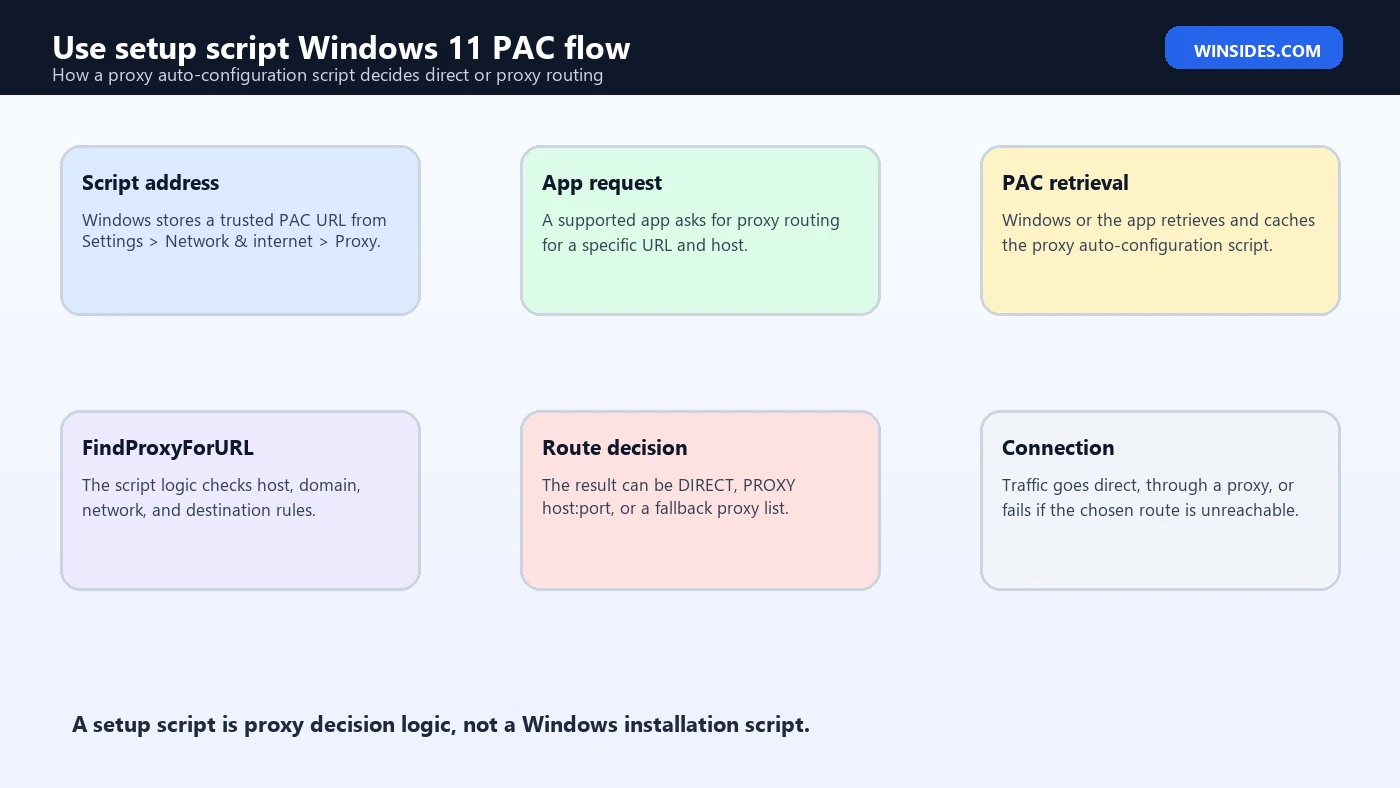
use setup script windows 11 usually refers to the proxy setting found under Settings > Network & internet > Proxy. It is part of the Automatic proxy setup area, where Windows lets you enter a script address for a proxy auto-configuration file, often called a PAC file. Instead of manually entering one proxy server and port for every destination, the setup script can decide whether each web request should go direct, use a proxy, or bypass the proxy for local or internal addresses.
This setting is common in offices, schools, managed laptops, VPN environments, and networks that route different sites through different proxy servers. Microsofts Windows proxy settings page is the official user-facing reference for configuring a proxy server in Windows. Microsoft Support proxy settings in Windows Microsoft also documents the lower-level WinHTTP auto-proxy behavior used by applications and services that need automatic proxy discovery or proxy script processing. Microsoft Learn WinHTTP auto-proxy support
The confusing part is the name. Use setup script does not mean a Windows installation script, a PowerShell setup file, or an app installer. In this context, the script is a network proxy configuration script. It normally uses JavaScript-like PAC logic with a function named FindProxyForURL. Windows and supported apps can use the script to choose the right network route.
This guide explains what Use setup script does in Windows 11, when you should enable it, how it differs from Automatically detect settings and manual proxy, what a PAC file is, why some apps follow the setting while others do not, how WinHTTP fits into the picture, and how to troubleshoot common problems when the script address breaks internet access.
Table of contents
Key Takeaways
- Use setup script Windows 11 is a proxy setting. It is not a Windows installation script or a general automation feature.
- The setting path is Settings > Network & internet > Proxy. Look under Automatic proxy setup and enable Use setup script.
- The script address normally points to a PAC file. A PAC file contains logic that tells supported apps whether to connect directly or use a proxy for a specific URL.
- Only use a script URL from a trusted source. A malicious proxy setup script can redirect browser and app traffic through an unsafe server.
- Automatically detect settings is different. It tries discovery methods such as WPAD, while Use setup script uses a specific script URL that you enter.
- Manual proxy is different again. Manual proxy sends traffic through one configured proxy server unless exclusions apply.
- Some system services use WinHTTP instead of the user proxy path. Microsofts WinHTTP documentation explains auto-proxy APIs and configuration behavior. Microsoft Learn WinHTTP auto-proxy support
- If the script URL is wrong or unreachable, internet access can break. Check the script address, DNS, network/VPN state, certificate trust, policy control, and app-specific proxy settings.
What Use Setup Script Means
Use setup script is a Windows 11 proxy configuration option. It tells Windows that a specific script address should be used to decide proxy routing. The script is normally a PAC file, which stands for proxy auto-configuration. The file usually has a .pac extension, but the extension is less important than the content and how the server provides it.
The PAC file contains logic. Instead of forcing all traffic through one fixed proxy server, the script can say things like: use a proxy for external websites, go direct for intranet addresses, send a certain domain through a regional proxy, bypass the proxy for local resources, or use a fallback proxy if the first one fails.
That flexibility is the reason enterprises use setup scripts. A single laptop may move between office networks, VPN, home Wi-Fi, and public networks. A fixed proxy server can be too blunt. A setup script can be more intelligent.
For home users, the setting is usually off. You should not enable it unless your organization, school, network administrator, VPN provider, or support documentation gives you a specific script address. If a random website tells you to paste a proxy setup script URL to unlock content, treat that as unsafe.
The setup script can influence where web traffic goes. That makes it powerful, but also sensitive.
Where to Find Use Setup Script in Windows 11
Open Settings, choose Network & internet, and then choose Proxy. Under Automatic proxy setup, look for Use setup script. Turn it on, enter the script address, and save the setting. The exact layout can change slightly with Windows 11 updates, but the route remains centered around Network & internet > Proxy.
The script address should be a URL provided by a trusted administrator or service. Examples often look like a web address ending in .pac, but organizations may use other URL forms. Do not guess the address. Do not copy a script URL from another network unless you know it belongs to your environment.
After saving the setting, close and reopen affected apps. Some applications read proxy settings when they start. Others detect changes dynamically. Browsers often respond quickly, but older apps may need a restart.
If you are troubleshooting, write down the original settings before changing anything. Proxy settings can break connectivity quickly. If the PC belongs to a company or school, the setting may be managed by policy. In that case, the toggle may be locked or changes may revert after sign-in, reboot, VPN connection, or device management sync.
What a PAC File Does
A PAC file is a small script that defines how to find a proxy for a URL. The central function is commonly called FindProxyForURL. The app or networking component provides the URL and host, and the script returns a proxy instruction such as DIRECT or PROXY with a server name and port.
In practical terms, the script answers a question: for this destination, should the PC connect directly or use a proxy?
A simple PAC rule might send local network addresses direct and send other traffic through a proxy. A more complex script might route different domains through different proxies, avoid proxy use for trusted internal resources, choose regional proxy servers, or provide fallback behavior if a proxy fails.
This is different from a manual proxy. A manual proxy is a fixed instruction. A PAC script is decision logic.
PAC files are useful, but they should be kept simple and reliable. If the script is slow, unreachable, too complex, or hosted on an unreliable server, users can experience slow browsing, app timeouts, Store problems, sign-in failures, update failures, and inconsistent behavior across apps.
Use Setup Script vs Automatically Detect Settings
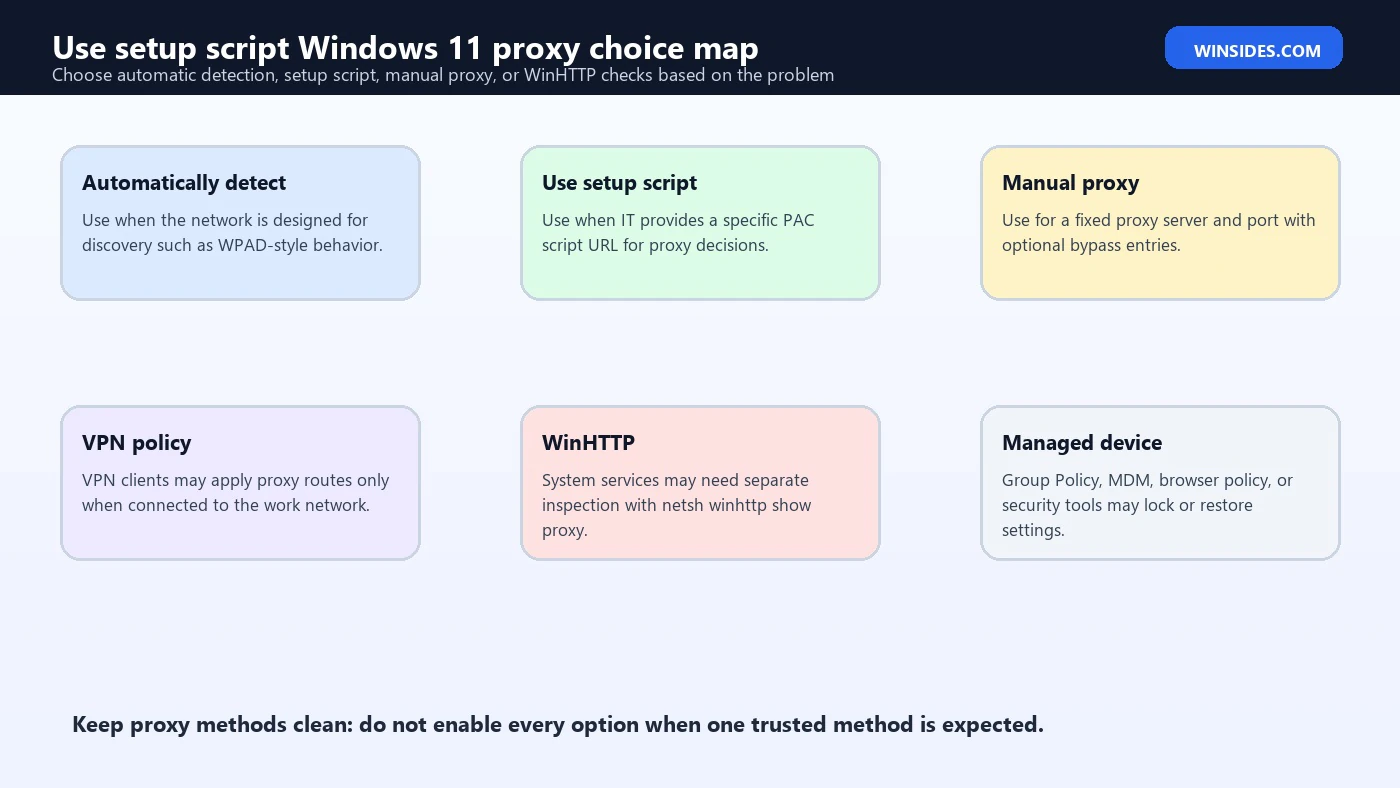
Windows 11 also has an Automatically detect settings option. This is not the same as Use setup script. Automatically detect settings tells Windows to try discovering proxy configuration automatically, commonly associated with WPAD behavior in managed networks. Use setup script tells Windows to use the specific script address you provide.
Automatically detect settings can be convenient in an enterprise network where the infrastructure is designed for it. A user does not need to know the script URL. The network provides discovery information. But it can also create confusion when a device moves between networks or when discovery is misconfigured.
Use setup script is more explicit. You enter the script address. That can make troubleshooting easier because there is a known URL to test. If the script URL is unreachable, wrong, blocked, or requires network access that is not available yet, the setting fails.
Many organizations choose one method and manage it with policy. You should not randomly enable both options unless your network documentation says so. Using both can make troubleshooting harder because you may not know which method is influencing the app.
Use Setup Script vs Manual Proxy
Manual proxy is the straightforward option. You enter a proxy server and port, then optionally add addresses that should bypass the proxy. It is easy to understand but less flexible.
Use setup script is better when routing needs to change based on the destination. For example, an organization might want intranet sites to go direct, general internet traffic to go through a proxy, Microsoft cloud endpoints to go through one route, and internal domains to use another path. A setup script can express those conditions.
Manual proxy can be useful for simple lab environments, temporary testing, or a small network with one proxy. But it can become fragile when users move between networks. If the proxy server is reachable only inside the office, the manual proxy can break the internet at home unless it is disabled.
A setup script can include fallback logic, but it is not magic. If the script itself is unavailable, badly written, or points to unreachable proxies, it can still break access.
When You Should Use Setup Script
Use setup script when a trusted administrator, school, VPN provider, or enterprise documentation gives you a script address. That is the cleanest case. You are not inventing proxy settings; you are applying a known network configuration.
It is also appropriate for managed environments where different network destinations need different proxy decisions. For example, internal resources may need direct access, while external web traffic must pass through a security proxy. A PAC file can make that routing consistent.
Use setup script can also help with VPN scenarios. Some organizations publish a proxy script that works only when the VPN is connected. The script may direct company resources through internal routes while allowing other traffic to go direct.
Avoid using setup scripts from random forums, free proxy websites, or untrusted downloads. A proxy script can route traffic through servers you do not control. Even if encrypted HTTPS protects content, the proxy path can still reveal destinations, create certificate warnings, break authentication, or expose metadata.
If you do not have a trusted script URL, leave the setting off.
How Apps Use Proxy Settings
Modern Windows apps, browsers, and desktop programs do not all use proxy settings in exactly the same way. Some use the Windows user proxy settings. Some use their own proxy settings. Some use WinHTTP. Some have enterprise policies. Some ignore proxies for certain traffic. This is why one app may work while another fails.
Browsers commonly follow Windows proxy settings unless enterprise policy or app-specific configuration overrides them. Microsoft Store apps and Windows components may use Windows networking APIs, but behavior can still vary based on service context and authentication.
System services can be different because they may run outside the signed-in user context. Microsoft documents WinHTTP auto-proxy support for applications and services that need automatic proxy behavior. Microsoft Learn WinHTTP auto-proxy support Microsoft also documents WinHTTP AutoProxy APIs for applications that need explicit proxy-script handling. Microsoft Learn WinHTTP AutoProxy API Microsoft also documents how WinHTTP can be configured from WinINET proxy settings. Microsoft Learn WinINET proxy configuration in WinHTTP This matters because a proxy setup script configured in the user interface may not automatically solve every service-level network problem.
If a browser works but Windows Update, activation, Microsoft Store, or a background service fails, do not assume the setup script is wrong. The issue may be which proxy stack that component uses, whether WinHTTP is configured, whether authentication is possible, or whether the service can access the script.
WinHTTP, WinINET, and Why They Matter
Windows has more than one networking stack involved in proxy behavior. Historically, many user-facing apps and browser-related settings used WinINET-style proxy configuration. Many services and system components use WinHTTP. This difference is one of the biggest reasons proxy troubleshooting feels inconsistent.
A proxy script entered in Settings can affect many user-context apps. But service-context components may need WinHTTP configuration or may handle auto-proxy differently. The command-line tool netsh winhttp is often used by administrators to inspect or configure WinHTTP proxy behavior.
For example, administrators may use:
netsh winhttp show proxyThat command shows the current WinHTTP proxy configuration. If the result says direct access, that does not necessarily mean the user proxy in Settings is off. It means WinHTTP is not configured with a proxy in that context.
Administrators may also import user proxy settings into WinHTTP with:
netsh winhttp import proxy source=ieThe command name still uses source=ie for historical reasons, even though Internet Explorer is no longer the normal browser on Windows 11. The key idea is that it imports the current user WinINET proxy configuration into WinHTTP. Use this only when you understand the environment or are following trusted administrator guidance.
Do not run random proxy commands blindly. They can break system services, updates, activation, Store access, and enterprise sign-in flows.
Common Setup Script Address Mistakes
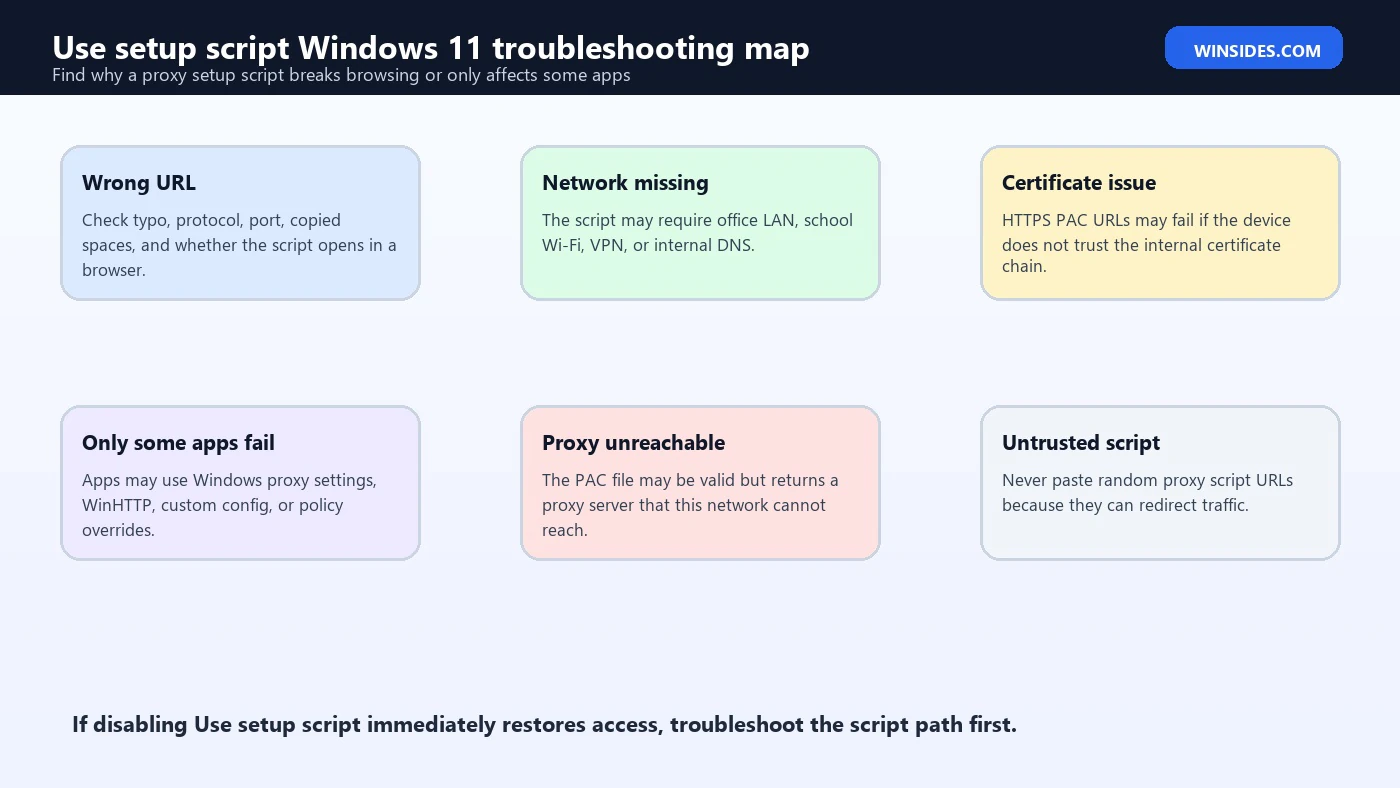
The most common mistake is a typo. A setup script address must be exact. A missing character, wrong protocol, copied space, incorrect port, or outdated hostname can make the script unreachable.
Another mistake is using a script that is reachable only inside a network while the PC is outside that network. For example, a company script URL may work only when connected to the office LAN or VPN. At home, the script address may not resolve or may be blocked.
Certificate issues can also break script access if the PAC file is served over HTTPS and the PC does not trust the certificate chain. This is common in enterprise environments using internal certificate authorities. If the device is not properly enrolled, it may fail to retrieve the script.
Authentication is another trap. A PAC script should normally be retrievable without complicated interactive sign-in. If the script URL requires a web login, some apps or services may not be able to fetch it reliably.
Finally, users sometimes paste a proxy server address into the script address field. The script address is not the same as the proxy server address. If the administrator gives you a proxy server and port, that belongs under manual proxy, not Use setup script, unless they specifically provide a PAC script URL.
Troubleshooting When Internet Stops Working
If the internet stops working after enabling Use setup script, first turn the setting off temporarily and test again. If internet access returns immediately, the script or proxy path is the likely cause.
Then verify the script address. Copy it carefully from trusted documentation. Open the URL in a browser if your administrator says it is safe to do so. You should usually see or download a PAC script. If the browser cannot reach it, Windows and apps probably cannot reach it either.
Check whether you are on the right network. If the script belongs to a company, connect the VPN or office network first. If it belongs to a school, ensure the device is on the school network or approved Wi-Fi.
Check DNS. If the script hostname does not resolve, the PC may be using the wrong DNS server or may not be connected to the network that hosts the PAC file. VPN DNS problems often show up as proxy script failures.
Check whether another setting is fighting it. Automatically detect settings, manual proxy, VPN client proxy rules, browser policies, security software, and device management policies can all affect the result.
If the PC is managed, do not keep changing settings randomly. Managed proxy settings may be applied by Intune, Group Policy, VPN software, endpoint security tools, or sign-in scripts.
Troubleshooting When Only Some Apps Fail
When only some apps fail, the setup script may be correct, but the failing app may not be using it. First test with a browser that follows Windows proxy settings. Then test a Microsoft Store app, a command-line tool, and the specific failing app.
If browser traffic works but a service fails, check WinHTTP. Use:
netsh winhttp show proxyIf the service uses WinHTTP and WinHTTP is direct, the service may not be using the same proxy script as the signed-in user. Microsofts WinHTTP documentation explains that WinHTTP has its own proxy configuration and auto-proxy APIs. Microsoft Learn WinHTTP auto-proxy support
If a command-line tool fails, check whether it uses environment variables, its own config file, Windows proxy settings, or no proxy support. Tools such as package managers, developer CLIs, and older utilities often have independent proxy configuration.
If a browser fails but other apps work, check browser policy and extensions. Enterprise browser policies can override Windows proxy settings. Extensions can also affect traffic, although managed environments often restrict them.
If Microsoft Store, Windows Update, activation, or sign-in components fail, involve the network administrator. Those services may need specific endpoint allow lists, authentication behavior, TLS inspection rules, or WinHTTP configuration.
Security Risks of Proxy Setup Scripts
A proxy setup script is powerful because it decides where traffic goes. That makes it a security-sensitive setting. A malicious or untrusted script can send traffic through a proxy controlled by someone else, block access to security sites, break updates, or direct users to manipulated internal resources.
Even with HTTPS, the proxy may see destination hostnames and connection metadata. In some environments, a proxy can also perform TLS inspection if the device trusts the proxy certificate. That is normal in some enterprises, but it should never be accepted casually from an unknown source.
Do not use setup scripts to bypass restrictions, unlock content, or follow random online advice. Free proxy lists and anonymous proxy scripts are not appropriate for a Windows system proxy setting. They can create privacy, security, and reliability problems.
For work and school devices, follow official IT instructions. For personal devices, leave Use setup script off unless you operate your own trusted network proxy or have a clear reason to use a PAC file.
Managed Devices and Policy Control
On managed Windows 11 devices, proxy settings may be controlled by policy. You may see messages such as settings managed by your organization, or the setting may revert after a while. That is expected when the device is controlled by IT.
Common management paths include Group Policy, mobile device management, VPN clients, endpoint security software, browser policies, and enterprise scripts. The user interface may show the result, but not the source of the setting.
If the device is managed, do not treat the proxy page as purely personal configuration. Changing proxy settings can affect access to internal sites, cloud services, software updates, device compliance, authentication, and security monitoring.
For administrators, proxy scripts should be hosted reliably, kept small, tested on multiple network types, and documented clearly. The script URL should be stable, reachable before dependent apps need it, and not require an interactive login just to download the PAC file.
For users, the main rule is simple: if IT gave the script address, use exactly that. If the device keeps restoring it, that is probably intentional.
Best Practices for Use Setup Script Windows 11
Use a trusted script address only. The best source is official organization documentation, a network administrator, or a managed device policy. Avoid public proxy scripts unless you own and understand the infrastructure.
Keep Automatically detect settings, Use setup script, and Manual proxy decisions clean. Do not enable every option just to see what works. Choose the method your network expects.
Document the original state before changing proxy settings. A quick note or screenshot can save time if the internet stops working.
Test the script URL directly when troubleshooting. If the PC cannot reach the script, it cannot use the proxy logic. Check DNS, VPN, Wi-Fi, certificate trust, and network location.
Remember that app behavior differs. Browser success does not guarantee system-service success. If services fail, inspect WinHTTP and involve IT.
Remove old proxy scripts when leaving an organization, changing VPN providers, repurposing a laptop, or moving to a network that no longer uses the PAC file. Old proxy settings are a common reason a PC suddenly cannot browse on a normal home network.
Practical Testing Checklist Before Saving the Script
Before saving a setup script on a Windows 11 PC, run a quick checklist. Confirm the script address came from a trusted source. Confirm whether it should be used only on VPN, only on a school network, only in the office, or everywhere. Confirm whether Automatically detect settings should be on or off at the same time. These details matter because proxy behavior is often environment-specific.
If possible, test the script address in a browser while connected to the expected network. A PAC file often opens as plain text or downloads as a small file. If the URL times out, shows a sign-in page, returns an error, or redirects to an unrelated page, do not assume Windows will handle it better. Fix access to the script first.
After saving the script, test a small set of destinations. Open an external website, an internal site, a Microsoft sign-in page, and any business app that depends on the proxy. If you are on a VPN, test before and after connecting. If the proxy is meant to protect web traffic, also test what happens when the VPN disconnects.
Keep one recovery path ready. Know how to return to Settings > Network & internet > Proxy and turn Use setup script off. If the setting is managed and you cannot change it, document the error and give the exact script address, network state, and failing app to the administrator. That information is far more useful than saying the internet is broken.
Common Command-Line Clues for Administrators
Administrators often need to compare user proxy settings with service-level proxy behavior. The first safe check is usually read-only:
netsh winhttp show proxyThis shows the current WinHTTP proxy configuration. It does not prove what every app is using, but it helps explain why a browser can work while a background service cannot. If WinHTTP says direct access and the organization expects service traffic to use a proxy, the service path may need separate configuration.
Another useful test is to check whether the PAC URL resolves from the same network context. DNS failures, VPN split-tunnel rules, internal certificate trust, and captive portals can all prevent the script from loading. A user may see a browser succeed after sign-in while a service still fails because the service cannot complete the same interactive step.
Do not change WinHTTP settings just because an article lists a command. Commands such as importing proxy settings into WinHTTP can affect Windows Update, Store, activation, enterprise sign-in, and security tools. In managed environments, apply them only through the documented IT procedure.
Frequently Asked Questions
What is Use setup script in Windows 11?
It is an automatic proxy setup option under Settings > Network & internet > Proxy. It lets you enter a script address, usually a PAC file URL, that tells supported apps whether to connect directly or through a proxy.
Is Use setup script a PowerShell script?
No. In this Windows 11 setting, the setup script is a proxy auto-configuration script, not a PowerShell script, install script, or Windows setup automation file.
Should I turn on Use setup script?
Turn it on only if a trusted administrator, school, company, VPN provider, or your own network documentation gives you a specific script address. Otherwise, leave it off.
Why does the internet stop after adding a script address?
The script URL may be wrong, unreachable, blocked, available only on VPN, affected by DNS issues, blocked by certificate problems, or pointing to a proxy server that your current network cannot reach.
Why do some apps ignore the setup script?
Different apps use different proxy paths. Some follow Windows user proxy settings, some use WinHTTP, some have their own settings, and some are controlled by enterprise policy.
How can I check WinHTTP proxy settings?
Administrators commonly use netsh winhttp show proxy. Be careful with changes, because WinHTTP settings can affect system services and background components.
Conclusion: Use Setup Script Only When the Proxy Path Is Trusted
Use setup script Windows 11 is useful when a trusted network needs automatic proxy decisions through a PAC file. It can route internal sites direct, send internet traffic through a proxy, handle different domains differently, and make managed network access smoother.
The same flexibility can also break connectivity or create security risk if the script address is wrong or untrusted. Treat the setting as a network control, not a casual tweak. Use the exact script address from your administrator, understand how it differs from automatic detection and manual proxy, and remember that WinHTTP and app-specific proxy behavior may need separate troubleshooting.
For more interesting articles, stay tuned to Winsides.com!







Community
Comments (0)